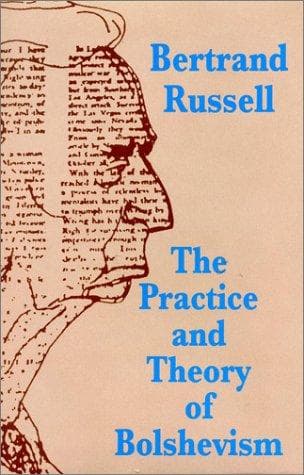
The Practice and Theory of BolshevismRussell, Bertrand
Religion
The Practice and Theory of Bolshevism
Russell, Bertrand
Communism -- Soviet Union -- History; Soviet Union -- Social conditions
There is, however, another aspect of Bolshevism from which I differ
more fundamentally. Bolshevism is not merely a political doctrine; it
is also a religion, with elaborate dogmas and inspired scriptures.
When Lenin wishes to prove some proposition, he does so, if possible,
by quoting texts from Marx and Engels. A full-fledged Communist is not
merely a man who believes that land and capital should be held in
common, and their produce distributed as nearly equally as possible.
He is a man who entertains a number of elaborate and dogmatic
beliefs--such as philosophic materialism, for example--which may be
true, but are not, to a scientific temper, capable of being known to
be true with any certainty. This habit, of militant certainty about
objectively doubtful matters, is one from which, since the
Renaissance, the world has been gradually emerging, into that temper
of constructive and fruitful scepticism which constitutes the
scientific outlook. I believe the scientific outlook to be
immeasurably important to the human race. If a more just economic
system were only attainable by closing men's minds against free
inquiry, and plunging them back into the intellectual prison of the
middle ages, I should consider the price too high. It cannot be denied
that, over any short period of time, dogmatic belief is a help in
fighting. If all Communists become religious fanatics, while
supporters of capitalism retain a sceptical temper, it may be assumed
that the Communists will win, while in the contrary case the
capitalists would win. It seems evident, from the attitude of the
capitalist world to Soviet Russia, of the Entente to the Central
Empires, and of England to Ireland and India, that there is no depth
of cruelty, perfidy or brutality from which the present holders of
power will shrink when they feel themselves threatened. If, in order
to oust them, nothing short of religious fanaticism will serve, it is
they who are the prime sources of the resultant evil. And it is
permissible to hope that, when they have been dispossessed, fanaticism
will fade, as other fanaticisms have faded in the past.
The present holders of power are evil men, and the present manner of
life is doomed. To make the transition with a minimum of bloodshed,
with a maximum of preservation of whatever has value in our existing
civilization, is a difficult problem. It is this problem which has
chiefly occupied my mind in writing the following pages. I wish I
could think that its solution would be facilitated by some slight
degree of moderation and humane feeling on the part of those who enjoy
unjust privileges in the world as it is.
Public-domain text, read in full here on John Shaqi.
Reviews
Reviews
No reviews yet
Be the first to share your thoughts on this work.
Join the Discussion
Join the discussion
Sign in to leave a comment or review.
Sign InorCreate an account