Reginald looked at the guide for an explanation; that worthy personage
shook his head, saying, “The boy talks riddles; but they are not hard
to guess. The good father must be some missionary, or priest; and
Olitipa would in their tongue signify ‘pretty prairie–fowl;’ so it is
probably the name of a Delaware woman—perhaps his sister.”
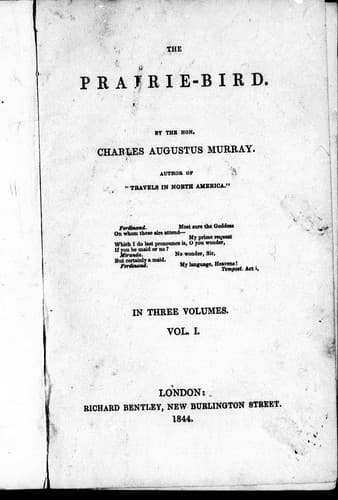
“_Kehella là_—so it is,” said the boy: “Olitipa is in your tongue
‘pretty prairie–bird,’ and she is my sister.”
“Where is Prairie–bird?” inquired Reginald, amused by the youth’s
_naïveté_.
“Far, far away, beyond the great river! But we will go back
soon;—shall we not?” inquired he, looking up timidly at War–Eagle.
“_Pechu lenitti_,[10]” answered the chief; and leaning towards the
youth, he added some words in a whisper, which made him start up to
obey the orders he had received.
Reginald was not long left in ignorance of their nature, as in a few
minutes the active lad had refreshed the fire, and was busy in broiling
some venison steaks, which, after the exercise of the morning, sent up
a steam far from unpleasant to the senses of any of those present.
“Master Reginald,” said the guide, “that silly perroquet of yours,
Gustave Perrot, is always telling fine stories of what he has seen in
Europe, and talking of the scent of roses, and the sweet sounds of
music, till the girls in the clearins think he’s a book–author and a
poet: did you ever smell any scent, or hear any music, sweeter than
comes from the hissing and frizzing of those slices of fat venison
after a six hours’ hunt in the woods?”
“Perhaps not,” said Reginald, laughing; “but we are only hunters, and
Monsieur Perrot is a man of taste.”
“Whom have we here,” grumbled the guide, as an Indian appeared in the
distance. “Friend War–Eagle, is this another of your band?”
“He is,” replied the chief: “all are now here.”
The new comer was a powerful, athletic–looking man: his face was
painted one half black, and the other half striped with bars of red;
the sleeves of his hunting–shirt were so short and loose, that his
naked arms were visible, one of which was tatooed in the form of a
lizard, and on the other he wore an armlet of brass; his leggins and
mocassins were soiled and torn, and the perspiration streaming from his
matted hair showed that he had travelled both far and fast. He was,
like the rest, equipped with rifle, tomahawk, and scalp–knife; his
countenance, as far as it could be distinguished through its disguise
of paint, was expressive of cunning and ferocity. Though probably much
surprised at seeing two white men sitting thus amicably with his chief,
he took little notice of them, or of the rest of the party; but without
asking, or being asked, any questions, seated himself on the opposite
side of the fire, lighted his pipe, and smoked.
“Master Reginald,” said the guide, in French, “I do not like that
fellow. I know not how he comes to be with our friend here, for he
belongs to another tribe; I have seen him before.”
Public-domain text, read in full here on John Shaqi.
Reviews
Reviews
No reviews yet
Be the first to share your thoughts on this work.
Join the Discussion
Join the discussion
Sign in to leave a comment or review.
Sign InorCreate an account