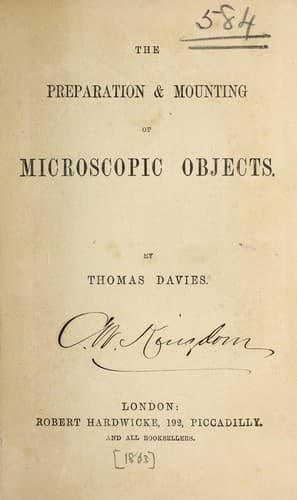
The preparation & mounting of microscopic objectsDavies, Thomas
Science
The preparation & mounting of microscopic objects
Davies, Thomas
Microscopy -- Technique
Often the cells must necessarily be of a large size, and for this
reason are made by taking four strips of glass of the thickness and
depth required, and grinding the places where these are to meet with
emery, so as to form a slightly roughened but flat edge. The glass
strip must also be ground on the side where it meets the plate, and
each piece cemented with the marine glue mentioned in Chapter I. in the
following manner:--On that part of the glass to which another piece
is to be attached should be laid thin strips of the glue; both pieces
must then be heated upon a small brass table, with the aid of the
spirit-lamp, until the strips become melted; the small piece is then
to be taken up and placed upon the spot to which it is to be attached,
and so on until the cell is completed. It will be found necessary to
spread the glue over the surface required with a needle or some other
instrument, so that an unbroken line may be presented to the wall of
the cell, and no bubbles formed. Too great a heat will “burn” the
marine-glue, and render it brittle; care must be therefore taken to
avoid this.
When shallow cells are required, those which are made by grinding
a concavity in the middle of an ordinary slide will be found very
convenient. The concavities are cut both circular and oblong; and the
surface being flat, the cover is easily fastened upon it. These are now
cheap, and are very safe as to leakage.
Circular cells with a flat bottom used to be made by drilling a hole
through glass of the required thickness, and fixing this upon an
ordinary slide with marine-glue; but the danger of breakage and the
labour were so great that this method is seldom used now, and, indeed,
the rings about to be mentioned do away with all necessity of it.
GLASS RINGS.--Where any depth is required, no method of making a cell
for liquids is so convenient as the use of glass rings, which are now
easily and cheaply procurable. They are made of almost every size and
depth, and, except in very extraordinary cases, the necessity for
building cells is completely done away with. These rings have both
edges left roughened, and consequently adhere very well to the slide,
this adherence being generally accomplished by the aid of marine glue,
as before noticed with the glass cells. Gold-size has been occasionally
used for this purpose; and the adherence, even with liquid in the
cell, I have always found to be perfect. This method has the advantage
of requiring no heat, but the gold-size must be perfectly dry, and
the ring must have been fixed upon the slide some time before use.
Canada balsam has also been used for the same purpose, but cannot be
recommended, as when it is perfectly dry it becomes so brittle as to
bear no shock to which the slide may be ordinarily exposed.
Public-domain text, read in full here on John Shaqi.
Reviews
Reviews
No reviews yet
Be the first to share your thoughts on this work.
Elsewhere in the archive
Join the Discussion
Join the discussion
Sign in to leave a comment or review.
Sign InorCreate an account