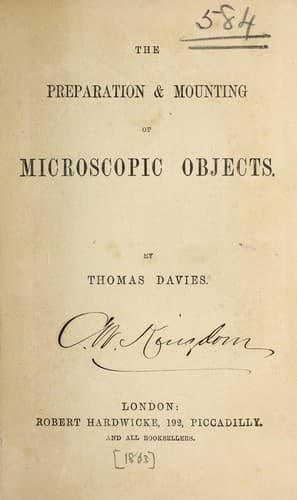
The preparation & mounting of microscopic objectsDavies, Thomas
Science
The preparation & mounting of microscopic objects
Davies, Thomas
Microscopy -- Technique
These are the cells which are mostly used in this branch of microscopic
mounting. The mode of using them, and the different treatment
which certain objects require when intended to be preserved in the
before-mentioned liquids, may now be inquired into.
I may mention, however, that this class of objects is looked upon by
many with great mistrust, owing to the danger there is of bubbles
arising in the cells after the mounting has been completed, even for
years. I know some excellent microscopists who exclude all objects
in cells and preservative liquids from their cabinets, because they
say that eventually almost all become dry and worthless; and this is
no matter of surprise, for many of them do really become so. Perhaps
this is owing to the slides being sold before they could possibly be
thoroughly dry. As to the air-bubbles, I shall have something to say
presently.
We will now suppose the cell employed is made by placing a glass
ring upon the slide with marine glue or gold-size, and is quite dry.
Around the edge of the cleaned thin glass which is to cover it, I
trace with a camel-hair pencil a ring of gold-size, and also around
the edge of the cell to which it is to adhere. Dr. Carpenter objects
to this, as rendering the later applications of the gold-size liable
to “run in.” All danger of this, however, is completely done away with
by leaving the slide and cover for awhile until the cement becomes
partially “fixed,” but still adhesive enough to perform its function
(Chapter II.). With many slides this is not accomplished in less than
twenty-four hours, even if left two or three days no injury whatever
ensues; but with other kinds an hour is too long to leave the exposed
cement, so that the operator must use his own discretion. The liquid
required may be drawn up by the mouth into the pointed tube mentioned
in Chapter I., and then transferred to the cell. In the various books
of instruction, the object is now to be placed in the cell; this,
however, I think a great mistake, as another process is absolutely
necessary before we advance so far. The cell, full of liquid, must
be placed under the receiver of an air-pump, and the air withdrawn.
Almost immediately it will be perceived that the bottom and sides of
the cell are covered with minute bubbles, which are formed by the air
that is held in suspension by the liquid. The slide may now be removed,
and the bubbles may require the aid of a needle or other point to
displace them, so obstinately do they adhere to the surface of the
glass. This process may be then repeated, and one cause, at least, of
the appearance of bubbles in cells of liquid will be got rid of. The
object to be mounted should also be soaked in one or two changes of the
preservative liquid employed, and, during the soaking, be placed under
the air-pump and exhausted. It may then be transferred to the cell,
which will probably cause the liquid to overflow a little. The cover
Public-domain text, read in full here on John Shaqi.
Reviews
Reviews
No reviews yet
Be the first to share your thoughts on this work.
Elsewhere in the archive
Join the Discussion
Join the discussion
Sign in to leave a comment or review.
Sign InorCreate an account