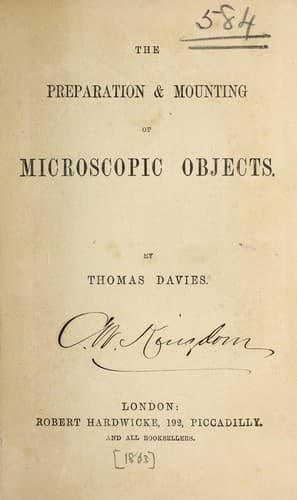
The preparation & mounting of microscopic objectsDavies, Thomas
Science
The preparation & mounting of microscopic objects
Davies, Thomas
Microscopy -- Technique
This making of sections was not until very recently entered into by
many except those belonging to the medical profession, but I do not see
why this should be so, as much may be accomplished by a persevering
and interested mind where there is time for entering into the subject.
I will therefore make an attempt to give some instructions on this
subject also. We will first consider the cutting of sections from hard
substances, in which the ordinary knife, chisel, &c., are of no avail.
Most of these require no particular care in mounting, but are placed in
balsam like the other objects noticed in Chapter III.: where, however,
any special treatment is necessary it will be commented upon as we
proceed.
SHELLS, &C.--It is seldom, if ever, necessary to possess apparatus
for this process except a small thin saw made with a steel blade, for
which a piece of watch-spring serves very well; a fine stone such as
is used for sharpening pen-knives; and two smooth leather strops,
one of which is to be used with putty-powder to polish the section
after grinding, and the other dry, to give the final surface. It is,
however, very convenient to have three or four files of different
degrees of fineness. The shell, if very thick, may be divided by
using the watch-spring saw; and this section may then with ordinary
care be rubbed down with water on the stone until one side of it is
perfectly flat. When this is accomplished it must be again rubbed with
putty-powder upon the strop, and finally upon the other strop without
the powder. This surface will then be finished and must be firmly
united to the slide in the position it is intended to occupy. To do
this a small quantity of Canada balsam may be dropped upon the middle
of the slide and heated over the lamp until on cooling it becomes hard;
but this must be stopped before it is rendered brittle. Upon this the
polished surface must be laid, and sufficient heat applied to allow
the object to fall closely upon the slide, when slight pressure may be
used to force aside all bubbles, &c. On cooling, the adherence will be
complete enough to allow the same grinding and polishing upon the upper
surface which the lower received. Whilst undergoing this, the section
must be examined from time to time to ascertain whether the necessary
degree of thinness has been reached. When this is the case the section
should be washed thoroughly and dried. It must then be covered, which
is best done by using the ordinary Canada balsam, as recommended in
Chapter III.
Public-domain text, read in full here on John Shaqi.
Reviews
Reviews
No reviews yet
Be the first to share your thoughts on this work.
Elsewhere in the archive
Join the Discussion
Join the discussion
Sign in to leave a comment or review.
Sign InorCreate an account