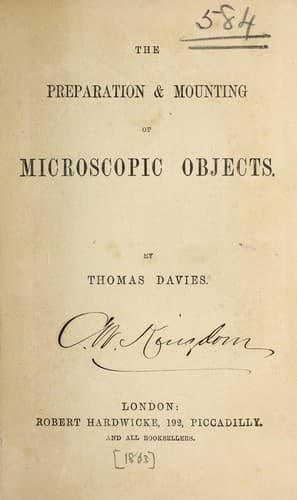
The preparation & mounting of microscopic objectsDavies, Thomas
Science
The preparation & mounting of microscopic objects
Davies, Thomas
Microscopy -- Technique
It is generally thought that Canada balsam injures the finer markings
of these sections, consequently, they are almost invariably mounted
_dry_. A thin piece is first cut from the tooth with the saw of
watch-spring before mentioned, if possible; but should the substance be
too hard for this, the wheel and lathe must be used with diamond dust.
If this cannot be procured, there is no alternative but to rub down the
whole substance as thin as practicable on some coarse stone or file.
The surface will then be rough; but this may be much reduced by rubbing
upon a flat sharpening stone with the finger, or a small piece of
gutta-percha, upon the object to keep it in contact. The scratches may
be much lessened by this, but not so thoroughly removed as microscopic
examination requires in dry sections. It must, therefore, be polished
with the putty-powder and dry strop, as recommended in the working of
the shell-sections. The other side of the section of the tooth may then
be rubbed down to the requisite thinness, and polished in the same
manner, when the dust and other impurities must be removed by washing,
after which the section must be carefully dried and mounted. Some of
these sections are equally interesting as opaque or transparent objects.
The dentine of the teeth may be decalcified by submersion of the
section in dilute muriatic acid; after drying and mounting in Canada
balsam it presents a new and interesting appearance, showing the enamel
fibres very beautifully when magnified about three hundred diameters. A
friend tells me that after submersion of the _whole tooth_ in the acid
he has been able to cut sections with a razor.
SECTIONS OF BONE.--With the aid of the microscope few fragmentary
remains have proved so useful to the geologist and students of the
fossil kingdom as these. From a single specimen many of our naturalists
can tell with certainty to what _class_ of animal it has once belonged.
To arrive at this point of knowledge much study is necessary, and
sections of various kinds should be cut in such a manner as will best
exhibit the peculiarities of formation. The methods of accomplishing
this will now be considered. It may, however, be first mentioned that
the chippings of some bones will be found useful now and then, as
before stated with flint, though this is by no means a satisfactory
way of proceeding. Sometimes the bones may be procured naturally so
thin that they may be examined without any cutting; and only require
mounting _dry_, or in _fluid_, as may be found the best.
Public-domain text, read in full here on John Shaqi.
Reviews
Reviews
No reviews yet
Be the first to share your thoughts on this work.
Elsewhere in the archive
Join the Discussion
Join the discussion
Sign in to leave a comment or review.
Sign InorCreate an account