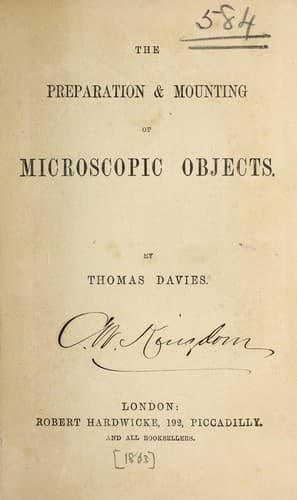
The preparation & mounting of microscopic objectsDavies, Thomas
Science
The preparation & mounting of microscopic objects
Davies, Thomas
Microscopy -- Technique
A _glass syringe_ is also useful in many operations, serving not
only to cleanse the objects but to add or withdraw liquids from the
_dissecting-trough_. This trough will now be described, as many
substances are so changed by becoming dry that it is impossible to
dissect them unless they are immersed in water during the operation.
If the object is opaque and must be worked by reflected light, a small
square trough may be made to the required size of gutta-percha, which
substance will not injure the edge of the knives, &c.; but where
transparency is necessary, a piece of thin plate-glass must be taken,
and by the aid of marine glue (as explained in Chapter IV.) the sides
affixed of the required depth. As pins, &c., cannot be used with the
glass troughs and the substance must be kept extended, a thin sheet of
cork loaded with lead in order to keep it under water may be used; but
this, of course, renders the bottom opaque. When working with many thin
substances, a plate of glass three or four inches long and two wide
will serve every purpose, and be more pleasant to use than the trough.
A drop or two of water will be as much liquid as is needed, and this
will lie very well upon the flat surface. As these are the principal
apparatus and arrangements which are requisite in dissection, the
method of proceeding in a few cases may now be noticed.
VEGETABLES.--The dissection of vegetable matter is much less
complicated than that of animal; maceration in water being a great
assistant, and in many cases removing all necessity for the use of the
knife. This maceration may be assisted by needles, and portions of
the matter which are not required may be removed by them. When, for
instance, the spiral vessels which are found in rhubarb are wanted,
some parts containing these are chosen and left in a small quantity of
water until the mass becomes soft, and this is more quickly effected
when the water is not changed. The mass must be then placed upon a
glass plate when practicable, or in the trough when large, and with
the aid of two needles the matter may be removed from the spiral
vessels, which are plainly seen with a comparatively low power; and by
conveying these to a clean slip of glass, repeating the process, and
at last washing well, good specimens may be procured. Most of these
should be mounted in some of the preservative liquids in the manner
described in Chapter IV. Many, however, may be dried on the slide,
immersed in turpentine, and then mounted in balsam; but liquid is
preferable, as it best preserves the natural appearance. Certain kinds
of vegetables require a different treatment to separate these spiral
vessels. Asparagus is composed of very hard vegetable matter, and some
have recommended the stems to be first boiled, which will soften them
to such a degree that they may easily be separated. Dilute acids are
also occasionally used to effect this; and in some instances to obtain
Public-domain text, read in full here on John Shaqi.
Reviews
Reviews
No reviews yet
Be the first to share your thoughts on this work.
Elsewhere in the archive
Join the Discussion
Join the discussion
Sign in to leave a comment or review.
Sign InorCreate an account