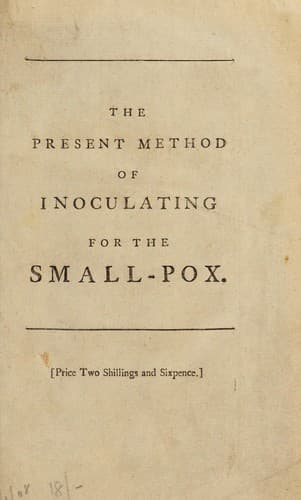
The Present Method of Inoculating for the Small-Pox: To which are added, some experiments, instituted with a view to discover the effects of a similar treatment in the natural small-poxDimsdale, Thomas
History
The Present Method of Inoculating for the Small-Pox: To which are added, some experiments, instituted with a view to discover the effects of a similar treatment in the natural small-pox
Dimsdale, Thomas
Smallpox -- Vaccination -- Early works to 1800
The child, however, seemed to be almost totally insensible during this
time, nor did he yet appear to be in any respect relieved by these
evacuations: blisters therefore were successively applied to the back,
head, and legs, and sinapisms to the feet; leeches were likewise fixed
to the temples, and rhubarb with calomel, after some little interval,
again directed; tin medicines being given between whiles.
By these means, though not till a considerable quantity of slimy and
extremely offensive fæces had been discharged, some signs of amendment
appeared. But the child still remained in some degree comatose till
the fifth day from this attack; after which the progress of amendment
was very quick, and in two or three days he got quite well, and has so
continued.
CASE XX.
In May 1776, I was desired to visit a considerable farmer, aged 68, to
give my advice for a complaint in his legs.
About two years before he had been seized with a numbness and coldness
in both legs and thighs, which it was apprehended would end in a
palsy. For this disorder he took many medicines, and both his legs
were blistered, by which he found relief; but from this time the legs
were affected with troublesome itching and burning pains, attended
with a sharp serous discharge through innumerable excoriations. These
complaints destroyed his rest, and made him unhappy.
After relating this case, he told me, that as almost every body in
the neighbourhood, who had not had the small-pox, was either under
inoculation or preparing for it, he could scarcely expect to escape the
infection, and had therefore a strong desire to be inoculated; and that
his wife of the same age with himself, was likewise desirous of it.
This proposal induced me to examine the present condition of his legs
more strictly. They were now, he said, in their best state; that is,
not so full of pain as usual; they were dry and scurfy. His face was
likewise scurfy, and of a settled deep red colour; the consequence, as
he told me, of a repeated Erysipelas in it, and not of any intemperance.
Upon considering the case, and reflecting that the preparatory course
of diet and medicine would probably amend the condition of his legs, I
encouraged him to pursue his intention; and both he and his wife, after
a fortnight’s preparation, were inoculated on the third of June.
On the 9th both made some slight complaints; and on the 12th the wife
grew better, on the appearance of a very few distinct pustules, which
maturated afterwards in the most favourable manner. But the man still
complained of pain and weariness till the 13th, when he grew easier in
that respect, and felt a smarting pain in his legs, which were very
red, and had several pustules on them. Towards evening they grew more
painful, more swelled, and a further eruption was discernable, though
not easy to be distinguished, by reason of their diseased state.
Public-domain text, read in full here on John Shaqi.
Reviews
Reviews
No reviews yet
Be the first to share your thoughts on this work.
Join the Discussion
Join the discussion
Sign in to leave a comment or review.
Sign InorCreate an account