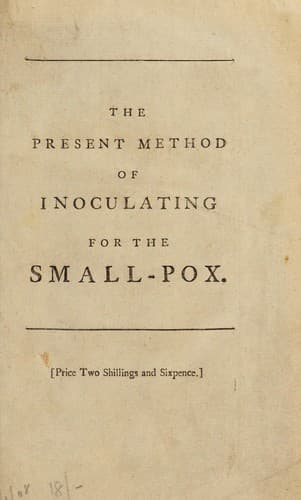
The Present Method of Inoculating for the Small-Pox: To which are added, some experiments, instituted with a view to discover the effects of a similar treatment in the natural small-poxDimsdale, Thomas
History
The Present Method of Inoculating for the Small-Pox: To which are added, some experiments, instituted with a view to discover the effects of a similar treatment in the natural small-pox
Dimsdale, Thomas
Smallpox -- Vaccination -- Early works to 1800
In respect to constitution, greater liberties may be taken than have
heretofore been judged admissible: persons afflicted with various
chronic complaints, of scrophulous, scorbutic, and arthritic habits;
persons of unwieldy corpulency, and of intemperate and irregular lives,
have all passed through this disease, with as much ease and safety as
the most temperate, healthy, and regular. But those who labour under
any acute or critical diseases, or their effects, are obviously unfit
and improper subjects. So likewise are those where there are evident
marks of corrosive acrimonious humours, or where there is a manifest
debility of the whole frame, from inanition, or any other cause: all
these should be treated in a proper manner previous to the introduction
of this disease. Constitutions disposed to frequent returns of
intermittents, seem likewise justly exceptionable; especially as the
preparatory regimen may in some habits increase this tendency. I have
known, however, instances of severe ague fits attacking persons between
the insertion of the matter and the eruption of the pock, and even
during maturation; when the Peruvian bark has been given liberally and
with success; the principal business, in the mean time, suffering no
injury or interruption.
Among the circumstances generally considered as more or less propitious
to inoculation, the season of the year has hitherto been deemed a
matter of some importance. Spring and autumn, for the most part, have
been recommended, as being the most temperate seasons; the cold of
winter, and the summer heats, having been judged unfavourable for this
process. But experience does not justify these opinions; for according
to the best observation I have been able to make, inoculated persons
have generally had more pustules in spring than at any other time of
the year; and epidemic diseases being commonly most frequent in autumn,
especially fluxes, intermittents, and ulcerated sore throats (all which
are liable to mix more or less with the small-pox) the autumn, upon
this account, does not seem to be the most favourable season in general.
My opinion is, that considering the surprizing and indisputable
benefits arising at all times to patients in the small-pox, from the
free admission of fresh cool air and evacuations (which will appear
from some cases hereafter subjoined) we may safely inoculate in
all seasons, provided care be taken to screen the patients as much
as possible from heat in summer, and to prevent them from keeping
themselves too warm, and too much shut up, as they are naturally
disposed to do, from the weather in winter. And it is well known, that
many have been inoculated in the depth of winter, and some during the
greatest heat in summer, without suffering any injury or inconvenience
from either.
Public-domain text, read in full here on John Shaqi.
Reviews
Reviews
No reviews yet
Be the first to share your thoughts on this work.
Join the Discussion
Join the discussion
Sign in to leave a comment or review.
Sign InorCreate an account