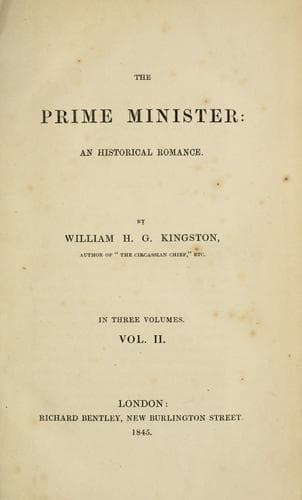
Portugal -- History -- Joseph, 1750-1777 -- Fiction
He persuaded the marchioness that gaiety was most likely to restore her
young friend to her usual state of spirits and health; and, perhaps, the
old lady was not sorry to discover a plausible excuse for opening her
palace once more to the gay world. Her father and brother wisely judged
that if they could give her a taste for the amusements of society, she
was less likely to wish to quit it. There was also to be a Beja Mao,
literally a kissing hands, or drawing-room, at the Court, when she was
to be introduced to the royal family, so that there was little time
afforded her for thought or meditation; indeed, very little would have
turned the scale, and made her accept the count at once; but she sought
to put off the day, which she knew must seal her misery, till the end of
the period allowed her.
The only person who appeared to be an indifferent spectator of what was
taking place, was the father confessor, Padre Alfonzo: he merely kept
his gaze fixed on her, with an ominous frown on his brow, whenever the
count was engaged in conversation with her; and his was, perhaps, the
only eye beneath which the glance of the young noble cowered.
A few days before the end of the month, the confessor encountered the
fidalgo alone: it was towards the close of the evening, as he was pacing
a long gallery of the palace, hung with the grim portraits of some of
his ancestors, who were those likewise of the marchioness.
"Your daughter appears inclined to obey your wishes," said the Priest.
"But if not, you remember your vow to our holy Church; and let your
heart be steeled, and your honour unsullied, as was that of your noble
predecessors. Let me feel confident that your wife's dying request may
be fulfilled, and again swear, that as long as the count urges his suit
to your daughter, she shall accept him, or become the bride of Heaven."
"Father, I have already said so, and I again swear, that she shall marry
the man I choose, or assume the veil," exclaimed the Fidalgo.
"I am satisfied," said the Priest.
END OF THE FIRST VOLUME.
Volume 2, Chapter I.
In painting a true picture of times and events, we must introduce among
our figures the wealthy and great, the wicked, the wretched, and the
indigent, or we should present no true likeness of the world as it
exists; but we must also beg leave to bring forward a personage who was
certainly not wealthy or great; who vowed that he was not wicked, for he
performed his duty to God and man; who was not wretched, for he was
singing all day long; while he declared that he could not be indigent,
for he possessed abundance to supply all his wants, though, fortunately
for himself, they were very few.
Public-domain text, read in full here on John Shaqi.
Reviews
Reviews
No reviews yet
Be the first to share your thoughts on this work.
Elsewhere in the archive
Join the Discussion
Join the discussion
Sign in to leave a comment or review.
Sign InorCreate an account