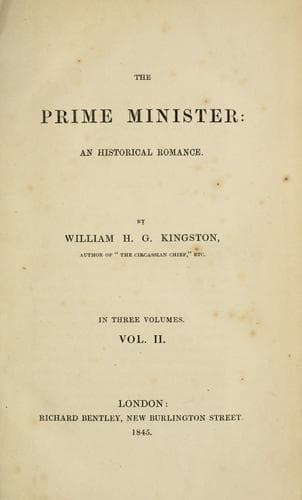
Portugal -- History -- Joseph, 1750-1777 -- Fiction
"Theresa," he said aloud, "it pains me to hear one of your soaring and
acute mind utter expressions worthy only of a foolish girl. Think of
the ends proposed. It is not the King I wish to injure; I alone seek to
counteract the machinations of that arch-enemy of your family, and of my
order, the Minister Carvalho. Could you once gain that complete
ascendency over the King which is within your power, you might not only
rule him, but the Minister himself would become powerless to injure any
of those connected with you by kindred and by love. Believe me, if you
hesitate, that treacherous man has sworn, and will not fail in his oath,
to ruin all your race, for their haughty contempt of his plebeian
extraction. Choose which course you will; allow your newly-raised
scruples to conquer your former resolution, and see all those you love
destroyed; or take the means of winning a power far greater than any
other female in the land can hold."
"But will the means you advise gain that power?" she asked, with a
doubtful tone. "Already have I lost much of my former influence with
the King. He begins to doubt the sincerity of my love, and accuses me
of coldness and indifference, urging me with prayers and entreaties to
give him stronger proofs of my affections, endeavouring to persuade me
to sacrifice my honour to his passion."
The priest of God looked steadily at the young girl. "Theresa," he
said, "I know that you are superior to the foolish superstitions of
mankind; and, being convinced of the fallacy of what many call the moral
rules of conduct, you will laugh at the prejudices which now cause you
to hesitate in performing a necessary duty. With us, the _only_ true
priesthood, rests alone the knowledge of what ought or ought not to be
performed under certain circumstances. There are rules necessarily
promulgated to keep in check the mass of mankind; but they are not
without exceptions. What is a crime when performed by one person,
becomes a virtue in another. It is the cause and effect of the action
which constitutes a crime. When a man in a fit of causeless anger,
slays another, he is guilty of murder; or when, to conceal previous
guilt, through revenge, or to wrench his gold, one kills another, he is
a murderer; but, with the same knife, and in the same way, a man may
kill another to attain some good end, or to punish guilt, and he has
performed a righteous deed. In the same way, if a woman, through the
frailty of her sex, yields to the temptation of passion, she commits
what is looked upon as a crime, according to the code at present
received as the rule of conduct; but should a woman employ those
captivating qualities with which nature has endowed her to attain some
desirable object, instead of committing a crime, she has performed a
meritorious action; the more so, that she has exposed herself to censure
from her fellow-creatures for the purpose."
Public-domain text, read in full here on John Shaqi.
Reviews
Reviews
No reviews yet
Be the first to share your thoughts on this work.
Elsewhere in the archive
Join the Discussion
Join the discussion
Sign in to leave a comment or review.
Sign InorCreate an account