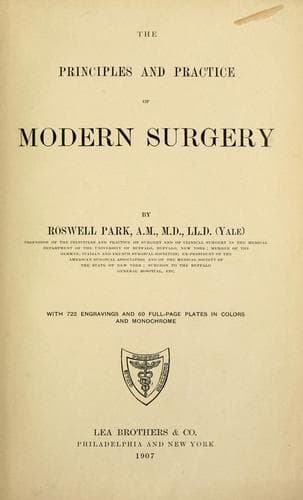
The principles and practice of modern surgeryPark, Roswell
Science
The principles and practice of modern surgery
Park, Roswell
Surgery
From these constantly menacing sources of intoxication man escapes by
virtue of his intestinal, cutaneous, pulmonary, and renal emunctories.
For instance, the usefulness of the perspiration is shown by the odor
which it assumes under the influence of certain disorders. Among
hypochondriacs and the inactive fatty acids are eliminated by the skin.
Hence the odors of hospital wards, asylums, prisons, etc. So, too, in
the case of many who suffer from deep-seated, indolent ulcers, the odor
of the skin is suggestive of the presence of pus. During twenty-four
hours there is eliminated from the lungs 1100 grams of carbon dioxide,
water, etc., which sometimes contain ammonia and various volatile
fatty acids; all of which will explain fetor of breath when it is the
result of incomplete nutrition and destruction of food. Of the _organs
of elimination_, the most important is the _kidney_, which does not
reabsorb a part of its own products, as does the intestine. The kidneys
eliminate fluids and solids, not gases. The most important of the toxic
principles contained in the urine are:
1. _Urea_, which plays an important and useful role in the economy,
since it possesses the property of forcing the renal barrier and
removing along with itself the water in which it is dissolved and other
toxic matters. Urea is toxic, but only in the sense that any other
substance, even water, may be--_i. e._, it is toxic only in large
doses, less than sugar, and no more than the most inoffensive salts.
This is contrary to generally received views, but is established by the
researches of Bouchard.
2. A _narcotic_ substance, and
3. A _sialagogue_ substance, whose composition is unknown;
4, 5. Two substances having the property of causing _convulsions_, one
having the power of _contracting the pupils_. The composition of both
is unknown.
6. A substance which _produces heat_ by diminishing heat
production--possibly a coloring matter. That coloring matters are
absorbed by charcoal and that urine thus decolorized is rendered less
toxic are no proof that the coloring matters themselves are responsible
for this toxic action. There is no doubt that numerous alkaloidal
bodies possessing a high molecular weight are precipitated by means of
carbon or charcoal, and to these bodies may be attributed a portion of
that toxic action previously considered as due to coloring matters.
7. _Potassium salts_, which are really convulsing agencies, are the
most toxic perhaps of any of the poisons contained in the urine.
Chloride of potassium, for instance, is toxic at 18 Gm. for every kilo
of animal.
Public-domain text, read in full here on John Shaqi.
Reviews
Reviews
No reviews yet
Be the first to share your thoughts on this work.
Elsewhere in the archive
Join the Discussion
Join the discussion
Sign in to leave a comment or review.
Sign InorCreate an account