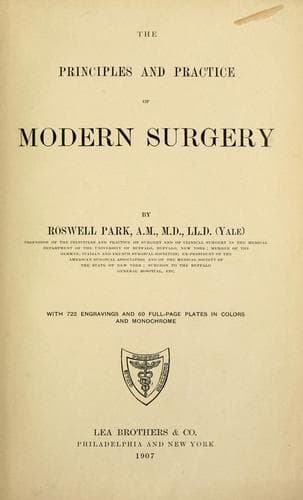
The principles and practice of modern surgeryPark, Roswell
Science
The principles and practice of modern surgery
Park, Roswell
Surgery
_Salivation_ and _myosis_, as well as diarrhea, are often noticed in
so-called _uremia_. In that form known as hepatic uremia, when the
liver no longer forms urea, the kidneys scarcely act. In other words,
if urea is no longer present in the body, the kidneys are deprived of
their principal stimulation to physiological activity. Consequently
urea, for so long a time the bugbear of physicians, is shown to be
most dangerous when absent. When urea is deficient, blood serum or
water in which the other toxic substances are dissolved should be
withdrawn. This is best done by _venesection_, whose value in so-called
uremia experience amply corroborates. When kidney activity ceases,
intoxication is likely to be produced by potassium salts. Ptomains,
amido bases, etc., are proved to be present in normal urine and are
known to produce toxic effect. These ptomains increase enormously in
pathological urines, and to this increase, rather than to that of
potassium and coloring matters (which remain fairly constant), may be
attributed the higher toxicity of pathological urine. In certain cases,
however, as in that of jaundice, the toxicity of the urine is partly
due to decomposition of tissue cells, whereby potassium salts and
organic decomposition products are liberated and excreted in the urine.
The toxicity of the urine also increases with the increase of indican,
which is indirectly a product of intestinal fermentation.
The _osmotic pressure_ of the blood has much to do with the general
subject of auto-intoxication, since it surrounds and permeates all
the organs of the body, which are necessarily in equilibrium with it.
Their individual cells functionate, then, in accordance with it, and
variations in such pressure must affect their activities. It is a
special function of the kidneys to eliminate enough of the accumulated
metabolic products in the blood to keep this osmotic pressure at
its normal. Should investigation or symptoms of disease show a wide
divergence from this standard, the inference is plain, _i. e._, that
there is renal insufficiency from impairment.
This test may be made with a small amount of blood by _cryoscopy_
(determination of freezing point). So, too, a determination of
_electrical conductivity_ may, in a similar way and for a similar
purpose, be made of clinical value. Unfortunately, these investigations
are not exactly simple in character, and are not available outside of
well-equipped hospitals.
Correct performance of _hepatic function_ is also necessary that
surgical cases may progress without disturbance. Bile escapes direct
absorption by the blood, but not all contact with it, since in the
intestine it is in contact with mesenteric capillaries, but must pass
again through the liver, which takes it up again and pours it once more
into the intestine.
Public-domain text, read in full here on John Shaqi.
Reviews
Reviews
No reviews yet
Be the first to share your thoughts on this work.
Elsewhere in the archive
Join the Discussion
Join the discussion
Sign in to leave a comment or review.
Sign InorCreate an account