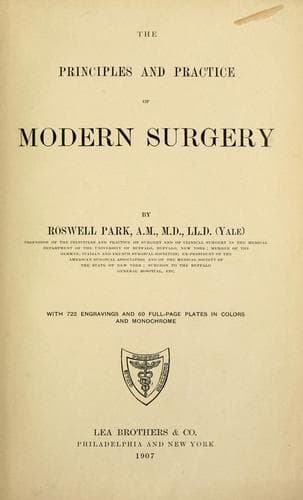
The principles and practice of modern surgeryPark, Roswell
Science
The principles and practice of modern surgery
Park, Roswell
Surgery
Among the most poisonous substances in the urine are the _extractive_
and _coloring materials_. Normal urine loses one-half of its toxicity
by decoloration; bile acts in the same way. _Urea_ alone represents
about one-eighth of the total toxicity of urine. _Ammonia_ is toxic,
but present in small amounts. The _coloring matters of the urine cause
two-thirds of its toxicity_, the remainder of which is to be ascribed
to its mineral salts, which it contains in the following proportion:
A liter of urine ordinarily contains 44 Gm. of solid matter, of which
32 are organic, 12 mineral. Of the latter, potassium salts constitute
3 Gm., sodium salts 7.5 Gm., and other earthy salts constitute the
remainder.
In these conditions physicians have relied largely upon purgatives,
hoping thereby to remove urea from the blood. But intestinal
elimination has no elective affinity for it, and removes it only in its
normal proportion with the balance of the blood. Purgatives, however,
help, first, by dehydrating the tissues--_i. e._, removing water with
toxic material in solution. But they should be followed by restoring
to the tissues pure water. By bleeding more extractives are removed
than by any other channel, except by the kidneys. A bleeding of 32 Gm.
removes from the body as much toxic matter as would 280 Gm. of a liquid
diarrhea or 100 liters of perspiration. This much may be removed by two
leeches. It is especially in the _subacute nephritis of scarlatina_,
etc., _that bleeding finds its greatest indication_. If the kidneys
are chronically diseased, the utility of bleeding is doubtful. Between
the arterial capillaries of the bowels, however, and the liver is
found a mass of blood accumulated in the _portal_ vessels. This may be
regarded as a reserve which can be thrown into the general circulation
when needed, in order that thereby arterial tension may be augmented
and the function of the kidney increased. _Cold injections_ into the
bowels will often accomplish this, and serious _anuria frequently
disappears after their use_. It is advisable, also, to make use of
urea by subcutaneous administration, as the most powerful diuretic
known, surface friction, caffeine, digitalis, etc., being far behind it
in efficiency. In the form of intoxication noted in the eclampsia of
puerperal patients _inhalations of chloroform_ are valuable. Potassium
salts should, under these circumstances, _never_ be employed. An
exposure of urine in compressed air will diminish its toxicity, on
account of contact with the oxygen; the most toxic bacteria are those
which grow without oxygen. Consequently patients inhaling this gas may
overcome this kind of auto-intoxication.
Public-domain text, read in full here on John Shaqi.
Reviews
Reviews
No reviews yet
Be the first to share your thoughts on this work.
Elsewhere in the archive
Join the Discussion
Join the discussion
Sign in to leave a comment or review.
Sign InorCreate an account