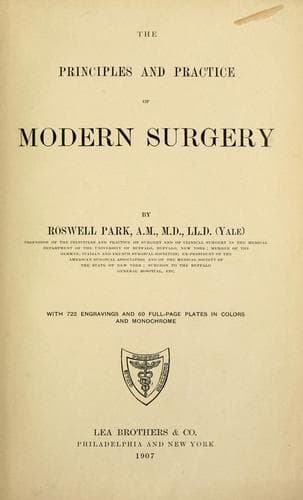
The principles and practice of modern surgeryPark, Roswell
Science
The principles and practice of modern surgery
Park, Roswell
Surgery
The value of an active liver is not appreciated by most surgeons to the
full extent. The blood of the _portal vein_ is so much more toxic than
that of the _hepatic vein_ that it is evident that the function of the
liver is to purify and remove the toxic material from the blood that
comes from the intestines. This has been called by Flint and others the
_depurative action_ of the liver. The activity of the liver also may be
proved by grinding up a freshly removed liver with alkaloids, whereby
the latter are chemically changed.
That the facts above stated, or others related thereto, have not been
lost sight of by surgeons is shown by such expressions as _septic
enteritis_, _enterosepsis_, etc., which are used by various writers. In
previous publications the writer has made a separate topic of so-called
_intestinal toxemia_, which he has preferred to introduce here as
one of the many possible auto-intoxications. It is a condition not
always permitting of exact definition, nor, still less, can the exact
toxic agency be indicated in a given case. Nevertheless, it has been
made plain that there is perhaps no condition which so _predisposes
to sapremia_, _septicemia_, or even _pyemia_ as this vague condition
of intestinal toxemia, which, notwithstanding, is so often present.
Many surgical patients present forms of blood poisoning in which the
poison has _not_ proceeded from the wound, for which the surgeon is
not responsible, except that he may have neglected to avail himself of
certain precautions.
The auto-intoxications, then, which have peculiar interest for the
surgeon may be conveniently classified as follows:
1. Those caused by failure in the function of particular organs; _e.
g._, myxedema, cretinism, and cachexia strumipriva from thyroidal
failure; pancreatic diabetes, where the islands of Langerhans are
invaded (interstitial pancreatitis, _q. v._); Addison’s disease from
adrenal failure (this being at present the prevailing belief).
2. Those caused by general disturbance of metabolism, where its
incomplete or abnormal products reach the general circulation, _e. g._,
oxaluria, gout, diabetes. (See Diabetic Gangrene.)
3. Those caused by retention in particular organs or tissues of
disturbed metabolic products, _e. g._, the toxemias following serious
burns and many septic conditions.
4. Those due to excessive formation of more or less normal products,
_e. g._:
(_a_) _Hydrothionemia_, _i. e._, the presence of hydrogen sulphide in
the blood. This results from one form of gastro-intestinal putrefaction
and causes violent symptoms with evidences of hydrogen sulphide
poisoning. It is seen in some cases of gastric dilatation, especially
those caused by pyloric obstruction (_q. v._).
Public-domain text, read in full here on John Shaqi.
Reviews
Reviews
No reviews yet
Be the first to share your thoughts on this work.
Elsewhere in the archive
Join the Discussion
Join the discussion
Sign in to leave a comment or review.
Sign InorCreate an account