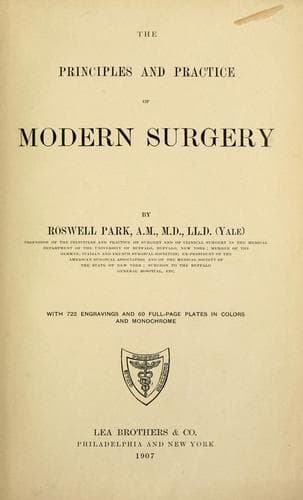
The principles and practice of modern surgeryPark, Roswell
Science
The principles and practice of modern surgery
Park, Roswell
Surgery
Formerly the surgical fevers were all grouped together, and a certain
amount of febrile disturbance was looked for after any injury. But
with the introduction of antiseptic methods and the healing of wounds
by primary union, with absence of all septic phenomena, and the use
of the clinical thermometer, it is noted that there is a certain rise
of temperature more or less quickly after an operation or reception
of a wound, with fever of mild grade, persisting for several hours or
two or three days, and with other accompaniments. This phenomenon has
been carefully studied, and so separated from the septic fevers as to
deserve a distinct recognition under the names above given, of which
the most common in this country is _surgical fever_.
As long as this fever is free from indications of septic character it
is without significance and needs only symptomatic treatment. It begins
usually within the first twenty-four or thirty-six hours, after which
the temperature may rise, progressively or with a morning remission,
to a height of 102° or possibly 103°. In children we are more likely
to get extremes in this regard than in healthy adults. It will be
followed by some disturbance of alimentary function, glazing or drying
of the tongue, deficiency in urinary secretion, and subside generally
spontaneously--invariably so if cathartics, diuretics, cool sponge
baths, etc., are used. It is usually due to the retention of blood
clot, ligatures, etc., or tissues which have been ligated and whose
stumps remain; in all instances there is some foreign material to be
removed. This means unusual phagocytic activity, perhaps temporary
leukocytosis, with active metamorphosis of clot and other material,
of all of which the elevated temperature is an accompaniment and
expression. It is not unlikely that the antiseptic materials used may
sometimes occasion this pyrexia.
Iodoform and carbolic acid are among the drugs in common use which are
known to be irritating and capable of producing toxic symptoms. Often
after the use of the latter the urine will be discolored and will
furnish the clue to the fever. In young children particularly, and not
infrequently in adults, mental disturbance, even active delirium, may
characterize the case. This is not always to be explained by cerebral
anemia due to loss of blood during the operation or accident, but
is probably due to drug toxemia or to intoxication from materials
furnished by the altered tissues.
_Surgical fever of strict type may merge into a more or less continuous
fever as the result of intestinal toxemia_ permitted by failure to
evacuate the bowels, and this _intestinal toxemia may be a predisposing
cause of genuine septic infection_. Consequently a surgical fever which
does not disappear within two days is to be viewed with suspicion,
especially if it does not subside after the administration of
cathartics.
Public-domain text, read in full here on John Shaqi.
Reviews
Reviews
No reviews yet
Be the first to share your thoughts on this work.
Elsewhere in the archive
Join the Discussion
Join the discussion
Sign in to leave a comment or review.
Sign InorCreate an account