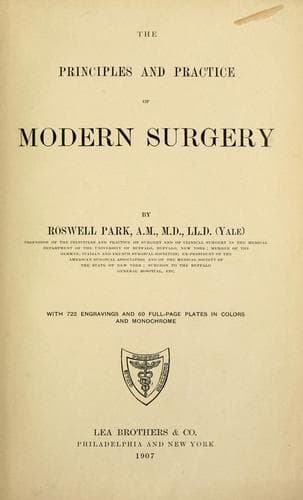
The principles and practice of modern surgeryPark, Roswell
Science
The principles and practice of modern surgery
Park, Roswell
Surgery
Some surgical fevers are accompanied by eruptions, a number of which
may be due to drugs and some to intrinsic poisons. Thus carbolic
acid and iodoform give rise occasionally to erythematous eruptions,
and the concomitant administration of drugs like potassium iodide,
quinine, antipyrine, and copaiba may produce urticarial or other
manifestations. Again, it is known that certain toxins--produced, _e.
g._, by the bacillus pyocyaneus--are capable of causing dilatation of
the superficial vessels and various flushes or eruptions. To one of
these, which dilates the capillaries, Bouchard has given the name of
_ectasine_. Consequently it by no means follows that every eruption or
rash following operations or injuries is of a specific character. On
the other hand it seems to be established by numerous observers--among
whom Paget is perhaps the most prominent--that surgical patients,
particularly the young, are particularly liable to infection by
scarlatina; and in the experience of Thomas Smith, of forty-three
children whom he cut for stone, ten had scarlet fever. Therefore, in
spite of the fact that a certain number of cases of eruption may
have been mistaken for scarlet fever, it is undoubtedly true that in
surgical and puerperal cases patients are more than usually liable to
this invasion. The use of antitoxins or serums is also occasionally
followed by intense urticaria.
The subject of surgical fever may then be epitomized as consisting of
elevation of temperature with certain accompanying disturbances, which
appear to be essentially due to the results of tissue metabolism,
including also metabolism of blood clot, ligatures, etc. It is not a
necessary nor conspicuous accompaniment of all surgical cases, and in
some individuals, even after grave operations, it will scarcely be
noted. It is more likely to be extreme in children than in adults.
As a result of excessive loss of blood it may be postponed. It may
be complicated and prolonged by any one of the auto-infections,
particularly that already mentioned in the preceding chapter as
intestinal toxemia, as a result of which septic infection may ensue,
and that which was at first a legitimate surgical fever may thus become
merged into a septic condition. In the absence of auto-infection, and
with appropriate treatment, surgical fever should quickly subside until
it becomes indistinguishable about the second or third day.
Proceeding then in the order of pathological complexities, the first of
the surgical infectious fevers to be considered is sapremia.
SAPREMIA.
The term _sapremia_ will be used here as indicating a condition which
is often likened to an _intoxication produced by a supposititious
septic suppository_. The term was first used by Duncan, and was largely
confined to puerperal cases. Some of the most ideal cases of sapremia
are those of puerperal origin.
Public-domain text, read in full here on John Shaqi.
Reviews
Reviews
No reviews yet
Be the first to share your thoughts on this work.
Elsewhere in the archive
Join the Discussion
Join the discussion
Sign in to leave a comment or review.
Sign InorCreate an account