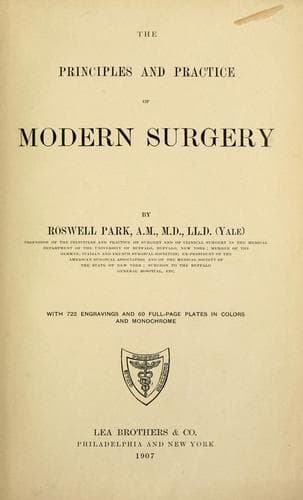
The principles and practice of modern surgeryPark, Roswell
Science
The principles and practice of modern surgery
Park, Roswell
Surgery
In each of the three conditions comprised under the general term of
_septic infection_ it is not now a question of particular organisms,
but of intoxication by products which are more or less common to at
least several of them. In a general way, they are mainly _due to the
activity of the organisms already grouped as pyogenic_. Those which
produce pus are capable of causing septic infection. In addition to
these, it is probable that certain of the saprophytes or ordinary
putrefactive organisms may produce the same effect.
=Symptoms.=--In sapremia the symptoms begin promptly, depend for
their intensity upon the dosage of poison, and recede quickly as
soon as the source of poisoning is removed or its activity subdued.
An instance of the possible causes of sapremia will perhaps best
illustrate its pathology. Take, for example, the act of delivery of
the full-term fetus. At the completion of this operation there is left
a fresh, bleeding wound of large area which is more or less exposed
to putrefactive agencies. This is reduced with the contraction of the
uterine walls to a comparatively small cavity containing more or less
freshly coagulated blood. As long as this clot does not putrefy it
is disintegrated inoffensively, to be discharged in large part with
the lochia. If germs of putrefaction enter, either during the act of
labor or afterward, and linger, putrefactive processes are set up in
the clot with the prompt production of certain toxins and ptomains.
There is here then a _septic suppository_ with conditions favorable
for absorption by the containing tissues. How quickly the poisoning
may show itself, and how soon it may subside after removal of the
putrefying clot, daily experience may tell.
_Sapremia then is intoxication produced by absorption of the results
of putrefaction of a contained material within a more or less closed
cavity_, whose walls are capable of absorption of noxious products
as they form. _As long as putrefaction is essentially limited to the
contained mass_, and does not spread to and involve the containing
or surrounding tissues the case is one of sapremia. _As soon as the
process spreads from the containing tissues the case merges from one
of sapremia into one of septicemia._ That this may occur in any case
without prompt intervention will be readily understood. Sometimes
patients may die of sapremia, though rarely, and in such case
ordinarily as the result of gross neglect. Once the septicemic process
is begun, however, its spread cannot always be checked, and the case
which one day is sapremic and redeemable may later become septicemic
and practically lost.
Public-domain text, read in full here on John Shaqi.
Reviews
Reviews
No reviews yet
Be the first to share your thoughts on this work.
Elsewhere in the archive
Join the Discussion
Join the discussion
Sign in to leave a comment or review.
Sign InorCreate an account