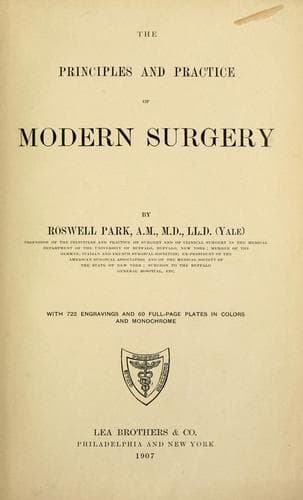
The principles and practice of modern surgeryPark, Roswell
Science
The principles and practice of modern surgery
Park, Roswell
Surgery
When _granulations_ are present the lymph sacs are closed, as by a
sanitary cordon. Unless this tissue is broken they are proof against
ordinary infection. It is well known that erysipelas will appear about
an old wound or sinus that has been rudely probed. Even virulent
organisms spread upon healthy granulating surfaces fail to infect.
Strong carbolic and other toxic agents can be used in and about such
granulating cavities with an exemption from poisoning that otherwise
would produce dangerous effects.
CHAPTER VIII.
SURGICAL DISEASES COMMON TO MAN AND DOMESTIC ANIMALS.
TETANUS.
Synonyms: _Trismus_, _Lockjaw_.
Tetanus is an _acute infectious disease_, of relatively infrequent
occurrence, _invariably of microbic origin, characterized by more or
less tonic muscle spasm with clonic exacerbations_, which, for the
most part, occurs first in the muscles of the jaw and neck, involving
progressively, in fatal cases, nearly the entire musculature of the
body. Certain _races_ of people seem predisposed, and in certain
climates and geographical areas the disease is exceedingly prevalent.
Negroes, Hindoos, and many of the South Sea Islanders show a peculiar
racial predisposition, and, in a general way, inhabitants of warm
countries are less resistant. This is shown partly by the fact that
in various European wars the Italians and French have suffered more
than the soldiers of more northern climes. Tetanus is by no means
confined to adult life, since infants are far from exempt, and in
the _tropics_ the _trismus of the newborn_ is the cause of a high
mortality rate. In Jamaica one-fourth of the newborn negroes succumb
within eight days after birth, and in various other hot countries the
proportion is at times equally great. One plantation owner states that
fully three-fourths of the colored children born upon his plantation
succumbed to the disease. The peculiar reason for this infection will
appear later when speaking of _tetanus neonatorum_. Men seem more
commonly affected than women, probably because of their occupations,
by which they are more exposed. Military surgeons have had to contend
with the disease in its most virulent form, and it has been noted
that soldiers when worn out by fatigue or suffering from the disaster
of defeat seemed more liable to the disease. In 1813 the English
soldiers in Spain suffered from tetanus in the proportion of 1 case
to 80 wounded men. In the East Indies, in 1782, this proportion was
doubled. Quick variations of heat and cold, such as warm days and cold
nights, coupled with the other exposures incidental to military life,
seem to exert a great effect. Curiously enough, the wounded in many
campaigns who have been cared for in churches have suffered more from
the disease than those cared for in any other way. Tetanus, however,
is by no means necessarily confined to any one clime or race, but may
be met with anywhere, at any time, providing only that infection has
occurred.
Public-domain text, read in full here on John Shaqi.
Reviews
Reviews
No reviews yet
Be the first to share your thoughts on this work.
Elsewhere in the archive
Join the Discussion
Join the discussion
Sign in to leave a comment or review.
Sign InorCreate an account