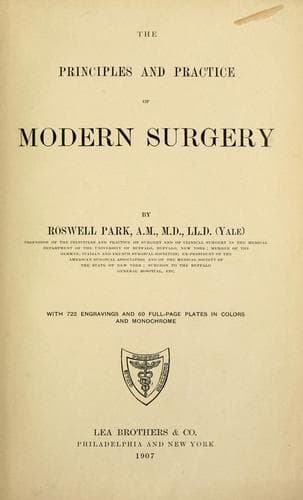
The principles and practice of modern surgeryPark, Roswell
Science
The principles and practice of modern surgery
Park, Roswell
Surgery
Even before the bacterial origin of the disease was accepted it had
been suggested to use _antiseptic applications_, either in watery
solution or combined with oil or some unguent; this is now the ideal
method of local treatment, the difficulty being only to find that
which shall be efficacious as an antiseptic, yet not injurious in
other ways. Compresses wrung in solutions of various antiseptics are
often serviceable. The following preparation has given satisfaction:
Resorcin (or naphthalin) 5, ichthyol 5, mercurial ointment 40, lanolin
50. The proportions of these ingredients may be varied, and the amount
of ichthyol sometimes increased, especially when the skin is not too
tender. The affected parts are anointed with this, and then covered
with oiled silk or other impermeable material, simply to prevent
its absorption by the dressings; the parts are then enveloped in a
light dressing and bandaged. Credé’s silver ointment has also proved
useful. As the disease becomes mitigated the ointment may be reduced
with simple lard, and discontinued when local signs have disappeared.
Absorption of any of these preparations may be hastened by scratches
over the affected area with the sharp point of a knife.
Treatment of _threatening phlegmon_, or phlegmonous erysipelas, must
be more radical, and consists of free incision down to the depth of
the deepest tissues involved. In treating dissecting and other septic
wounds of the fingers incision should be made to the tendon sheaths,
even to the bone. It is only by such radical measures that worse
disaster may be avoided. Some aggravated local cases are treated by a
series of deep incisions with the use of the curette, the surface after
careful clearing being kept buried under an antiseptic solution (silver
lactate 1 to 500) or ointment.
RELATION OF LYMPH NODES AND GRANULATION TISSUE TO INFECTION.
In connection with erysipelas and the _role_ of the lymphatics, it is
advisable to consider the relation and behavior of the lymph nodes and
granulation tissue to infecting agents. Depending on the virulence of
the infectious material, the site of infection, and the variety of the
microbe will be its arrival in these protective filters. Then follows a
series of cycles of maximum and minimum activity in the nodes, during
the former the bacteria almost disappearing. The more pathogenic the
microörganism the more certain the destruction of the lymph node, or
perhaps of the individual. The well-known enlargement of the nodes is
due almost solely to an increase in their lymphoid elements. Halban,
who demonstrated these cyclic variations in the contents of the lymph
nodes, is inclined to insist on an intimate relation between them and
the temperature variations noted in cases of septic infection.
Public-domain text, read in full here on John Shaqi.
Reviews
Reviews
No reviews yet
Be the first to share your thoughts on this work.
Elsewhere in the archive
Join the Discussion
Join the discussion
Sign in to leave a comment or review.
Sign InorCreate an account