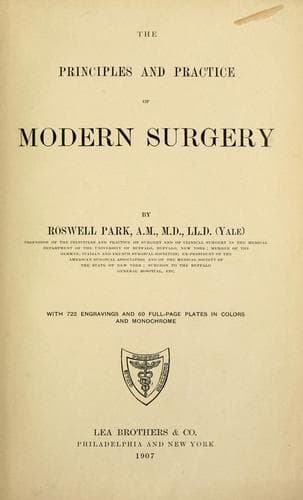
The principles and practice of modern surgeryPark, Roswell
Science
The principles and practice of modern surgery
Park, Roswell
Surgery
The most hopeful of remedies is _antitoxin_. More lives can be saved by
this preparation, if used _early_ and freely, than by any other known
remedy. Moschcowitz, in 1900, collected 338 cases, with a mortality
of 40 per cent. In many of these cases it was not used early. It is
of importance, however, to use it at the very outset, and to repeat
its use as soon or as often as may be indicated by any exacerbation of
symptoms. In one instance under my observation twenty-three phials of
antitoxin were used before muscle rigidity subsided; in another case
double this amount was used. Without quoting figures it is safe to
say that the former great mortality rate of tetanus has been _reduced
at least 50 per cent._ by its use, and that further reduction can be
effected by its early and prolonged use.
The use of antitoxin nowise takes away the necessity for proper
physical care of the laceration or the wound. Every particle of
affected tissue should be cut away, all the principles of physical
cleanliness adhered to, and proper antiseptics used.
When the antitoxin is used in the presence of the disease it should be
injected into the spinal canal, as it is known that the cerebrospinal
fluid may contain a considerable amount of the toxin and is of itself
highly poisonous. Therefore after inserting the needle into the canal
it is well to withdraw a considerable amount of the fluid before
injecting the antitoxin. If this method is pursued the material is
brought into more immediate contact with the anterior horns of the
cord than could be effected in any other way. After withdrawing all
the fluid that will run through the needle without applying the
syringe--probably 150 to 200 Gm.--10 to 15 Cc. of the antitoxin may
be slowly injected, the process consuming from three to five minutes.
Then a further injection should be made along some of the large nerve
trunks, preferably those leading to the part involved. This injection
should be made with a finer needle, such as that with which cocaine
solution is injected during anesthesia for the prevention of shock.
This is a more effective and less serious matter than trephining the
skull for the injection of fluid upon the surface of the brain. This
may be done while the patient is under the influence of the anesthetic
administered for the purpose of giving proper attention to the wound.
The antitoxin should be injected into the nerve trunks after their
exposure. At the same time it is well to make intravenous saline
injections at more than one point. After from twelve to fifteen hours
the injection of antitoxin and perhaps of saline solution should be
repeated, if necessary, under such light anesthesia as can be produced
by ethyl chloride. Recently a substitute for antitoxin has been
suggested in an emulsion of brain tissue which has been shown to have
a specific affinity for the tetanus toxin. It has been seen that when
these two substances have been thoroughly shaken together the toxin
Public-domain text, read in full here on John Shaqi.
Reviews
Reviews
No reviews yet
Be the first to share your thoughts on this work.
Elsewhere in the archive
Join the Discussion
Join the discussion
Sign in to leave a comment or review.
Sign InorCreate an account