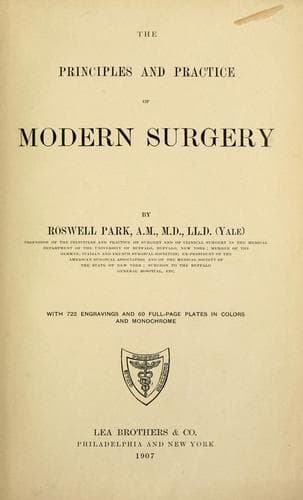
The principles and practice of modern surgeryPark, Roswell
Science
The principles and practice of modern surgery
Park, Roswell
Surgery
=Prognosis.=--Prognosis for man is not usually unfavorable, the
majority of cases recovering with more or less local destruction of
tissue. Should, however, infection become generalized, the case will
probably terminate fatally. Cases assuming the type of splenic fever
are of much more serious character, and their prognosis graver.
=Treatment.=--This should be both local and constitutional. The
former should consist of the most radical possible attack and include
complete excision of the infected area, with the use of active caustics
or the actual cautery. In fact, the latter instrument offers a most
valuable means for combating the destructive tendency of the disease.
Sloughing and separation of the cauterized mass may be hastened by
warm antiseptic poultices. Subcutaneous injections of 5 per cent.
carbolic solution have been given, with apparent benefit, in a number
of cases, but should only be relied upon in the treatment of the milder
manifestations.
Benefit will accrue from the use of the ichthyol-mercurial ointment
whose formula was given under treatment of Erysipelas. It has been
suggested to treat these cases by the employment of the bacillus
pyocyaneus, since it is known that this organism when injected with the
anthrax bacillus materially attenuates its effect.
=Prophylaxis.=--Prophylaxis is most important. The bodies of all
infected animals should be burned, not buried, since the resistant
bacilli are often brought to the surface of the soil by earth-worms.
Every discoverable source or medium of infection should be destroyed or
sterilized.
MALIGNANT EDEMA.
This disease has been recognized for some time, mainly by French
and Continental clinicians, and under such names as _gangrène
foudroyante_, _gangrène gazeuse_, _gangrenous septicemia_, and
_gangrenous emphysema_. The name _malignant edema_ was given by Koch,
who identified the infecting organism. It is one of the most dangerous
forms of gangrenous inflammation, and occurs sometimes after serious
injuries, and, again, after most trifling lesions, such as those
inflicted by the dirty pointed implements of the gardener, etc., or
even the stings of insects. Two cases are on record where the disease
followed a puncture of the hypodermic needle for the administration of
morphine. In one of these the organism was found in the solution; in
the other it probably had been deposited upon the skin.
Public-domain text, read in full here on John Shaqi.
Reviews
Reviews
No reviews yet
Be the first to share your thoughts on this work.
Elsewhere in the archive
Join the Discussion
Join the discussion
Sign in to leave a comment or review.
Sign InorCreate an account