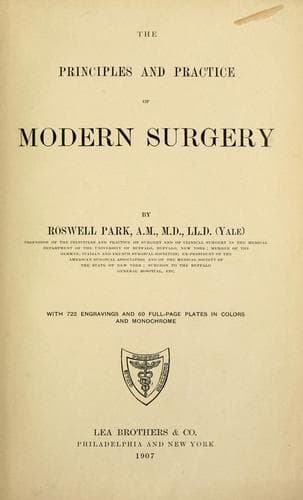
The principles and practice of modern surgeryPark, Roswell
Science
The principles and practice of modern surgery
Park, Roswell
Surgery
In other words, the majority of cases of
tuberculous pyarthrosis are due to primary bone disease. As the result
of the tuberculous infection the bones become distorted, which is best
illustrated in Pott’s disease of the spine; while, as the result of
the constant irritation, joint ends become displaced by chronic muscle
spasm, and joint contours entirely altered by expansion of the affected
bone and thickening and infiltration of the overlying soft parts.
I have often, for the sake of illustration to medical students,
drawn a certain analogy (following Savory) of the gross resemblances
between lungs and bones in their behavior when involved in tuberculous
disease. In either case the structure is in a measure spongy and
contains cavities and networks of tissue; in each case the structures
are invested by a resisting membrane--in the one instance pleura,
in the other periosteum. Again, each is closely related to a serous
cavity--the lungs to the pleural cavity, the bones to the serous
cavities of the joints. Tuberculous disease manifests a predilection
for the extremities of both organs. Perforation into the adjoining
serous cavity is frequent, and previous to perforation collections
of serous fluid are frequently noted--in one instance pleurisy, in
the other hydrarthrosis. Moreover, these fluids may frequently become
contaminated, and then become purulent, constituting empyema or
pyarthrosis as the condition may be. One sees, too, in each place the
same striking combinations of weakening of tissue and strengthening in
order to atone for the undermining of the disease. These are not all of
the similarities that might be adduced, but are perhaps sufficient for
the purpose of showing that tuberculous disease is essentially one and
the same thing, no matter what tissue is invaded.
_In the tendon sheaths and bursæ_ we frequently find manifestations
of tuberculosis. When seen early these are always in the direction
either of miliary affection, or, most commonly, of tuberculous gumma,
while when seen late the disease has usually advanced to the point of
suppuration, and we now have cold abscess of the affected part.
Public-domain text, read in full here on John Shaqi.
Reviews
Reviews
No reviews yet
Be the first to share your thoughts on this work.
Elsewhere in the archive
Join the Discussion
Join the discussion
Sign in to leave a comment or review.
Sign InorCreate an account