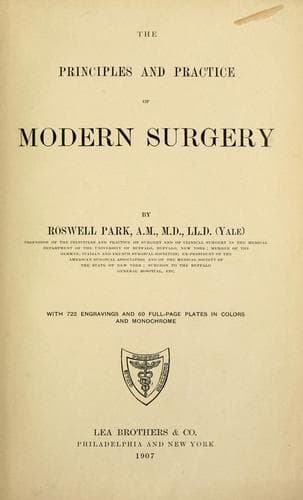
The principles and practice of modern surgeryPark, Roswell
Science
The principles and practice of modern surgery
Park, Roswell
Surgery
In many joints and tendon sheaths, particularly the latter, we find
certain detached, usually colorless, firmly resistant masses, of
smooth and polished surface, lying in a collection of fluid, in size
from a minute particle up to that of a melon-seed. These have been
known at various times as _rice grains_, _melon-seed bodies_, _corpora
oryzoidea_, etc., and for a long time their explanation was a mystery.
It is now well established that in the majority of instances these
are the result of fungous granulations which have become detached in
small pieces, which then, in the absence of infection, have shrunken
and become rounded and polished by attrition. The bursal enlargement
and distention with fluid in which they are usually found is commonly
spoken of as _hygroma_ of that particular bursa. Tuberculosis of these
bursæ, however, does not always result so harmlessly as the formation
of these bodies, but, on the contrary, tuberculous infiltration may
extend beyond the serous limits to the surrounding soft parts, with
a tendency finally to external escape, just as in the case of bone
lesions. These constitute affections of the soft parts which are more
or less destructive, and are difficult, often impossible, to deal with,
because of the mutilation which a thorough extirpation of the disease
would necessitate.
_In the testicles and ovaries_, particularly in the former, tuberculous
disease is frequently met with. In the testicles it begins usually in
the _epididymis_, forming a somewhat dense nodule and a distinct tumor,
easily observed from the outside, although its minute character may be
still concealed. The tendency here is almost invariably to progressive
infiltration and breaking down, either into a caseous mass or, more
commonly, into puruloid material, while sometimes acute infection
supervenes.
It is not always easy to distinguish between syphilis and tuberculosis
of the testicle, though the latter is usually characterized by the same
tendency to effusion into the adjoining serous cavity, _i. e._, that
of the tunica vaginalis, as is manifested in disease of the lungs or
bones. When the disease is extensive the overlying skin is involved,
and frequently the surgeon is called to deal with cases of perforation
and escape of fungoid tissue on the outside.
_In the kidneys, in the ureters, as also in the bladder_, tuberculous
lesions are noted, the miliary form being particularly frequent in
the former. Tuberculous disease of the kidney leads sooner or later
to caseation and a condition of pyonephrosis or its equivalent, which
calls practically always for extirpation of the affected organ.
Tubercle bacilli are sometimes recognized in the urine, but only when
the lesion has an opportunity of discharging into one of the urinary
passages.
Public-domain text, read in full here on John Shaqi.
Reviews
Reviews
No reviews yet
Be the first to share your thoughts on this work.
Elsewhere in the archive
Join the Discussion
Join the discussion
Sign in to leave a comment or review.
Sign InorCreate an account