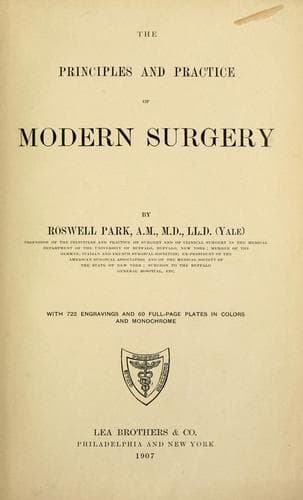
The principles and practice of modern surgeryPark, Roswell
Science
The principles and practice of modern surgery
Park, Roswell
Surgery
=Evolution of the Disease.=--Ever since the days of Ricord’s writings
on the subject it has been customary to group the manifestations of
syphilis into three groups or stages: _the primary_, _the secondary_,
_and the tertiary_. Less stress is laid upon these stages than
previously, yet it is convenient to retain them for descriptive
purposes. It should be emphasized, however, that between them there are
no arbitrary limits of time or tissue. _Primary_ syphilis under this
classification includes the first period of incubation and the symptoms
and appearances of the initial lesions. _Secondary_ syphilis may be
made to include the earlier constitutional symptoms which involve or
at least become apparent upon the more superficial portions of the
body, _i. e._, skin, mucous membrane, lymphatics, etc. Later comes
the so-called _tertiary_ period, in which the body surfaces are not
necessarily spared, but in which also deep lesions of the viscera, the
bones, the brain, etc., are noted. Between the first and the second
stages comes the so-called second period of incubation. The second and
third stages are characterized by frequent neoplastic formations, which
assume the type of the infectious granulomas and are commonly spoken of
as gummas; these lesions are destructive in their tendency, and will so
prove unless dissipated or aborted by suitable treatment.
_In the first and second stages of the disease it can be conveyed by
inheritance and inoculation_; in the later stage such an occurrence is
exceptional.
That syphilis is, _per se_, an infection is proved by the
constitutional symptoms which accompany its earlier manifestations; the
fever, usually mild, though sometimes well marked, which comes early
in the course of the disease, the general lymphatic involvement, the
malaise and depression, all indicate the systemic disturbances of a
true toxemia.
The periods of quiescence between successive outbreaks of the disease
are, moreover, characteristic, although they sometimes lull the patient
and his physician into an inactive state, during which medication is
too often suspended, so that when fresh disturbance arises vigorous
treatment must be renewed.
_The infection of syphilis occurs on the instant of inoculation_, as in
the case of tetanus. This is important, as upon it depends the question
of early local treatment. While excision of the primary sore, or even
of an area which might have become infected during exposure, and before
the actual formation of the chancre, has been often practised and urged
by some, experience has shown that it has little to commend it, since
the general experience is that it does not prevent the development of
the disease.
Public-domain text, read in full here on John Shaqi.
Reviews
Reviews
No reviews yet
Be the first to share your thoughts on this work.
Elsewhere in the archive
Join the Discussion
Join the discussion
Sign in to leave a comment or review.
Sign InorCreate an account