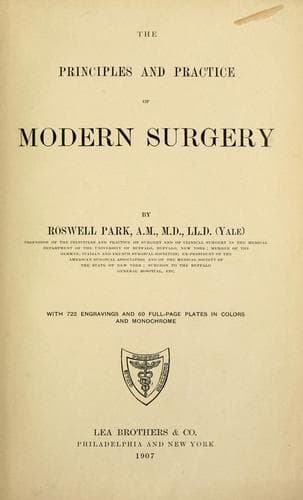
The principles and practice of modern surgeryPark, Roswell
Science
The principles and practice of modern surgery
Park, Roswell
Surgery
In its tendency syphilis is constantly progressive and destructive,
although it often behaves in a capricious manner, sometimes when under
efficient treatment and generally when treatment is inefficient. It
is usually more virulent in the dissipated and those who are weakened
by inheritance or poor constitutions, or by other disease. One reads
in literature on the subject about the malignancy of some cases and
the benignancy of others. Some cases seem to have a malignant aspect,
while others run an unusually mild course, so much so as to raise the
question whether the patient had syphilis. As far as the nature of the
parasitic cause is understood, this would depend on differences in the
make-up of the individual rather than in the actual virulence of the
germ. In the extremes of life individuals are more susceptible. When
implanted upon a tuberculous constitution it sometimes renders the
tuberculous lesions more active; whether it acts as a mixed infection
is not definitely known. Tuberculous lymph nodes frequently break down
during the course of secondary syphilis, and consumptive patients grow
rapidly worse. Syphilis, like alcohol, tends to play havoc with the
bloodvessel walls, and their combined effects in this direction are
greatly to be deprecated and should be prevented.
=The Lesions and Secretions which Convey Infection.=--As far as
acquired syphilis is concerned _absolute contact_ is necessary between
the infecting material and the infected area, while upon the latter
must exist some abrasion of the surface. Chancres and the early
eruptions or mixed lesions have been proved to be absolutely virulent.
The genitalia of both sexes are frequently the site of wart-like
lesions referred to as condylomas, which are usually kept more or less
moistened by the secretion of the parts, and are fruitful sources of
contagion. _The discharging lesion of those suffering from syphilitic
disease should be regarded as capable of transmitting it_, while during
the primary and secondary stages the blood and lymph should be regarded
as probable sources of danger.
Inoculation with the blood of patients during these stages has been
known to be successful. How long the blood retains its power of
infection is uncertain; it is usually regarded as free from it when the
disease is latent.
The _natural and physiological secretions of various organs_, _e.
g._, saliva, milk, perspiration, tears, and urine, are not generally
believed to _be capable of transmitting the disease_. The semen of
syphilitic men may reproduce the disease by heredity but not by direct
inoculation. It is possible under these circumstances for the father
to transmit the disease to the ovum without previously infecting the
mother; such infection of the ovum by diseased spermatozoa is quite
different from the infection of the ovum by the mother who has acquired
the disease, the father having escaped it.
Public-domain text, read in full here on John Shaqi.
Reviews
Reviews
No reviews yet
Be the first to share your thoughts on this work.
Elsewhere in the archive
Join the Discussion
Join the discussion
Sign in to leave a comment or review.
Sign InorCreate an account