The principles and practice of modern surgery — John Shaqi
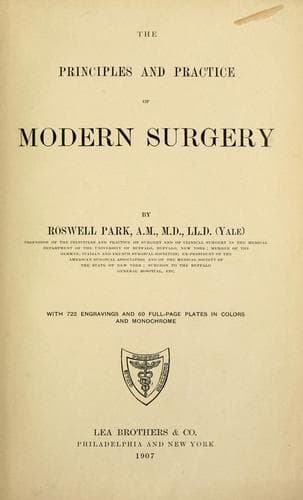
The principles and practice of modern surgeryPark, Roswell
Science
The principles and practice of modern surgery
Park, Roswell
Surgery
7. _Specific_ forms of pathological atrophy are largely connected with
disturbances in the central nervous system. They are often referred
to as _trophoneurotic_. Their exact mechanism is not yet understood,
and cases may be confused under this head whose remote causes are
widely different. Here should be included, for instance, the atrophy
of a deep bone which occurs after extensive burn of the surface; also
that peculiar form of atrophy of tissues in the stump which produces
the so-called _conical stump_. These cases are of a more complicated
character, for if pressure is removed from the bone end, especially
in young people, the bone tends to grow faster than it should, while
the soft parts disappear, partly as the result of mere disuse or loss
of function. In this way conicity is produced, which sometimes calls
for subsequent re-amputation. Under this head might also be included
the so-called “trophic inflammation” (misnomer) of some writers,
such, for example, as ulceration of the cornea after division of the
trigeminus. The general subject of _atrophic elongation_ also belongs
here, referring to the fact that as a result of disuse, or sometimes
of active disease, the bones, while showing atrophic changes in other
respects, actually increase in length. Should such increase occur in
one bone of those portions of the limbs which are supplied with two,
the result would be posture deformity and displacement of the terminal
portion.
CHAPTER II.
SURGICAL PATHOLOGY OF THE BLOOD.
The part played by the constituent elements of the blood in
inflammation, suppuration, and other still more disastrous conditions
is so great and so important that, before proceeding to discussion of
these lesions, it seems necessary to set forth a _resume_ of facts
illustrating the importance of accurate knowledge concerning this most
important fluid.
The total amount of blood in the human body has been variously
estimated at from one-eleventh to one-twenty-fifth of the body weight,
the average being about one-sixteenth. The amount which the body may
lose and still retain vitality is very vague and differs not only with
individuals, but very greatly under various conditions. Severe loss
of blood is one to be atoned for as quickly as possible, and is to be
prevented as far as it can be after accidents or during operation. For
this reason the so-called bloodless method of operating upon limbs, by
the use of the rubber bandage, constituted a great advance in surgery.
For the same reason the use of hemostatic forceps is of equal value
in operating upon other parts of the body; other things being equal
the quickest and most satisfactory recoveries follow the bloodless
operations, and it is an advantage to conserve this vital fluid as far
as possible.
Public-domain text, read in full here on John Shaqi.
Reviews
Reviews
No reviews yet
Be the first to share your thoughts on this work.
Join the Discussion
Join the discussion
Sign in to leave a comment or review.
Sign InorCreate an account