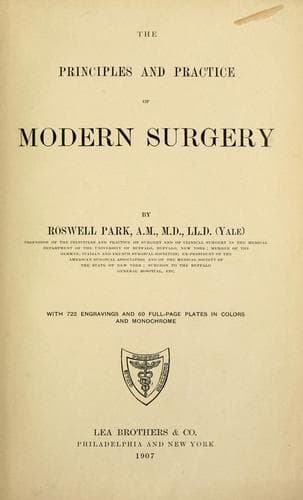
The principles and practice of modern surgeryPark, Roswell
Science
The principles and practice of modern surgery
Park, Roswell
Surgery
Joint complications in this disease have been recognized from the
earliest times. One hundred and fifty years ago Strack expressed
himself thus: “If the dysenteric poison affect only the chest, it
causes asthma; if the limbs, it produces arthritis; if both, abscess.”
Joint pains and swellings, with other suppurations, have been noted in
several of the epidemics of this disease which have ravaged various
parts of the world at different times. Postdysenteric arthritis
may assume noticeable and even pyemic aspects, and is occasionally
fatal. The bones and joints may become involved in painful and even
suppurative swellings, not alone during the active stage of the
disease, but during the period of convalescence; while mildness of
the primary attack does not necessarily provide immunity from later
complications. Here thrombosis of large veins or thrombophlebitis are
also observed. When the joints are involved it is usually in irregular
order and not simultaneously. Joint lesion does not necessarily proceed
to suppuration, but perhaps only to the point of edema and fluid
exudation or hydrops. In the Cuban and South African campaigns, during
which dysentery prevailed, joint complications were noted.
CHOLERA.
Cholera is usually too rapid and too violent in its course to be
followed by secondary infections. Nevertheless, Poulet reports from
Val-de-Grace several instances of articular and osseous lesions, some
of these characterized by effusion of fluid which was sometimes very
thick and resembled balsam, while at other times pus was present.
PNEUMONIA.
Pneumonia having now taken its place as a distinct germ disease, and
the micrococcus of Fränkel and the capsule coccus of Friedländer
being well established as the active agents in the two principal
forms of this disease, pus may be found in other parts of the body.
The most common surgical sequels of pneumonia occur as postpneumonic
pyarthrosis, which has been wrongly considered a rheumatic affection.
These lesions are of embolic or of metastatic origin.
INFLUENZA, OR LA GRIPPE.
This disease has assumed prominence in medical literature, and not
a few instances have been reported of surgical sequels--abscesses,
purulent ear disease, pyarthrosis, bone lesions, etc. Even necrosis has
been repeatedly observed.
MEASLES AND SCARLATINA.
The infectious agent in these affections is not yet recognized and
their surgical sequels should be regarded as due to secondary pyogenic
infections.
Surgical tuberculosis appears often as a sequel of the exanthemas.
In the lymphatics, periosteum, bones, and joint cavities, and in and
about the eye and ear, manifestations of suppurative disease are often
found. It is believed that these sequels are likely to appear when the
eruption has been incomplete. Hyperplastic thickening of periosteum and
neuralgic pains of the affected parts occur without suppuration, hence
the rheumatic character which Bonnet and others have wrongly ascribed
to these manifestations.
Public-domain text, read in full here on John Shaqi.
Reviews
Reviews
No reviews yet
Be the first to share your thoughts on this work.
Elsewhere in the archive
Join the Discussion
Join the discussion
Sign in to leave a comment or review.
Sign InorCreate an account