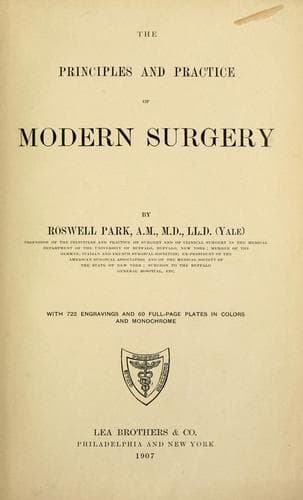
The principles and practice of modern surgeryPark, Roswell
Science
The principles and practice of modern surgery
Park, Roswell
Surgery
While the absence of pus takes these out of the category of pyogenic
infections, it nevertheless leaves them still as surgical complications
which have often to be dealt with by mechanical measures, such as
orthopedic apparatus, etc.; while more or less formidable operations,
as for relief of ankylosis, have to be performed. Postscarlatinal
arthralgia may be explained as a local ischemia; so may acute swelling
or chronic thickening. But pus is an expression of infection, and
cannot be otherwise regarded. Retropharyngeal abscesses and a peculiar
necrosis of the alveolar process of the jaws, described by Salter,
are among the various serious surgical complications of scarlatina.
Epiphyseal separations and purulent destruction of ribs have also been
noted.
TYPHOID FEVER.
Although in elaborate treatises, as by Liebermeister and Murchison,
there is no mention of bone and joint complications as sequels of
typhoid, they have, nevertheless, been recognized by surgeons.
Post-typhoid hip dislocations have been reported by several German
surgeons. Boyer observed spontaneous dislocation of both thighs after
what he called “essential fever,” and the general topic of spontaneous
luxations subsequent to typhoid has been frequently discussed.
Those affections of joints formerly considered rheumatic occur
much less often after typhoid than after dysentery. Nevertheless,
post-typhoidal arthralgia and myodynia have been recognized by several
French writers. Some with affected joints, supposed to be rheumatic,
have later been discovered to be suffering from genuine typhoid
fever, and it has been afterward recognized that the joint lesion was
a bizarre expression of the typhoid poisoning. The works on general
practice call attention to the frequent complications of the pleural
and pericardial serous membranes in this disease. They say little,
however, about the implications of the articular serous membranes,
though one is as easy to explain as the other. Post-typhoidal
polyarticular serous arthritis has been described by more than one
writer. Multiple joint abscesses have been rarely seen. Pus has been
known to collect not only in the joints, but also in the tendon sheaths
and bursæ. The lymph nodes are also frequently affected, and cervical,
axillary, and inguinal abscesses are not rare. Post-typhoidal
pyarthrosis, as leading to spontaneous luxation, has had a medicolegal
interest, for luxation has been known to occur while raising or lifting
a patient, the question of violence being subsequently brought into
court. When the joint disease assumes the mono-articular form it is
likely to terminate in suppuration; when polyarticular, pyarthrosis is
less common. In the pus from many of these abscesses typhoid bacilli
may be recognized, but by no means in all. The writer has found them in
a case of abscess in the abdominal wall occurring during convalescence
from typhoid in a young woman. A non-suppurative but painful form of
periostitis is occasionally observed.
Public-domain text, read in full here on John Shaqi.
Reviews
Reviews
No reviews yet
Be the first to share your thoughts on this work.
Elsewhere in the archive
Join the Discussion
Join the discussion
Sign in to leave a comment or review.
Sign InorCreate an account