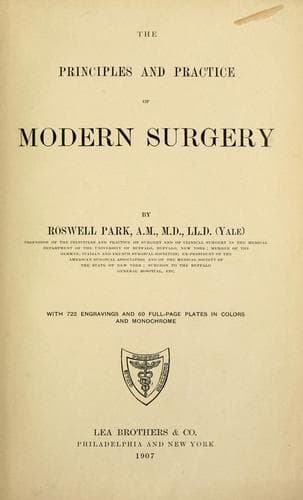
The principles and practice of modern surgeryPark, Roswell
Science
The principles and practice of modern surgery
Park, Roswell
Surgery
I have never seen more exquisite
tenderness nor expressions of suffering than I met in a case of this
kind in a boy in whom the bones of both lower extremities, of the
pelvis, and the lower spine were involved. The slightest jar upon the
floor would make him exclaim with pain, and to minister to his ordinary
wants was a distressing task. He eventually recovered without any pus
formation. Deep suppuration in bones occasionally occurs, and even
necrosis with separation of sequestra.
Thrombosis and thrombophlebitis are also well-known sequels of typhoid,
which may lead to unpleasant complications. Typhoid fever appears
to bear a peculiar relation to the growth of bones, as it has been
noticed that during its course, or during convalescence, they show an
extraordinarily rapid growth in length, even to the extent of 1 Mm. a
day. This is probably caused by the irritation of the typhoid toxin
upon the osteogenic tissue, since hyperemic areas have been found in
the bone-marrow of those dying of the disease, and bone pains are a
frequent accompaniment of the disease. Typhoid bacilli have the power
of remaining latent in the tissues for a long time after cessation of
active symptoms, and have been found alive and capable of active growth
seven months after cessation of the fever. Remembering the multiple
ulcers of the lymphoid tissue which characterize the intestinal lesions
of typhoid, it is difficult to explain pyogenic or other septic
infection by absorption through these open ports of entry; and the
typhoid bacilli themselves, entering the circulation through these
paths, may be carried to all parts of the body, and have been found in
the pia.
A large amount of interest has attached to the so-called “_surgery of
typhoid fever_,” which, however, has been permitted to include only
abdominal section for perforation of intestinal ulcers. The mortality
due to this accident is nearly 70 per cent.--_i. e._, is formidable.
It occurs generally during the third week. It is usually preceded by
leukocytosis, and is followed by profound shock. Operation offers
almost the only hope. It has been successful in about one out of five
cases. (See Surgery of the Intestines.)
Post-typhoidal infections of the _biliary and pancreatic ducts_, with
their resulting complications, play a conspicuous part in the etiology
of biliary obstruction. They are regarded as among the most common
causes of acute and chronic or latent disease in these passages.
DIPHTHERIA.
Public-domain text, read in full here on John Shaqi.
Reviews
Reviews
No reviews yet
Be the first to share your thoughts on this work.
Elsewhere in the archive
Join the Discussion
Join the discussion
Sign in to leave a comment or review.
Sign InorCreate an account