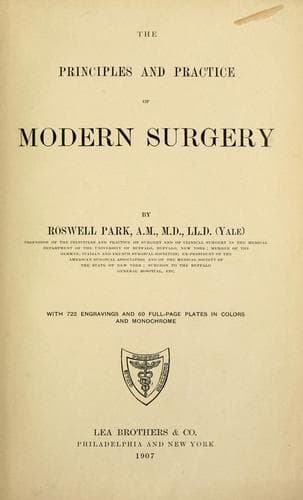
The principles and practice of modern surgeryPark, Roswell
Science
The principles and practice of modern surgery
Park, Roswell
Surgery
The normal blood pressure in healthy adults is 130 to 140 Mm. of
mercury in the tube. In children it ranges from 90 to 110 Mm. Females
have an average lower pressure of 10 Mm.
Excitement or slight stimuli will send the pressure up thirty or forty
points. It is also higher than the above average in arteriosclerosis.
In uremia it is always high. In cases of intracranial tension it is
also high, as the brain alone of all the organs of the body has no
complete vasomotor apparatus of its own; when it needs more blood this
has to be contributed from the general supply. When pressed upon by a
clot, depressed bone, or foreign body it becomes anemic, and on effort
to furnish the needed blood from other parts the vascular tonus is
increased. Cushing has shown the value of these estimations in cases
of _head injury_, for the rise of blood pressure may be regarded as an
indication for operation. In typhoid fever a sudden rise of pressure is
associated with perforation, or perhaps with the peritonitis which is
its immediate result. On the other hand, in this disease a sudden fall
of pressure is an indication of hemorrhage.
The course of events in surgical shock is about as follows: Injury to
afferent sensory nerves acts as a vasomotor stimulus after it reaches
the centre in the fourth ventricle; a reflex impulse is then sent out
which produces arterial contraction and raises the blood pressure.
When the abdomen is concerned the opening and handling of its contents
produce the same result through the splanchnic centres. If, however,
the stimulus is excessive, too often repeated, or too prolonged the
vasomotor grip is lost, the arterioles dilate, and the blood pressure
is reduced. A severe injury to any part of the body may produce this
effect without the preliminary rise. The popular impression that a
patient “bleeds to death into his own veins” has this to justify
itself, that the arterial tonus is lost and the blood is pumped through
the arterioles to accumulate in the capillaries and veins, especially
the abdominal, thus overloading the right side of the heart and giving
it a disproportionate amount of work.
Accompanying these circulatory disturbances are others, secondary and
unavoidable, as of respiration, which becomes rapid and enfeebled in
proportion to the degree of shock.
Any factor which tends to weaken the heart’s force favors both
phenomena. So important is the respiratory action that patients die
from cessation of respiration rather than from impairment of the
circulation. This shows the importance of maintaining artificial
respiration in cases of severe shock.
Public-domain text, read in full here on John Shaqi.
Reviews
Reviews
No reviews yet
Be the first to share your thoughts on this work.
Elsewhere in the archive
Join the Discussion
Join the discussion
Sign in to leave a comment or review.
Sign InorCreate an account