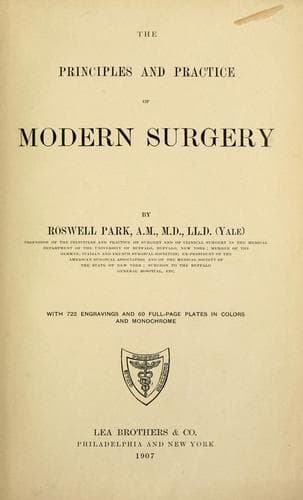
The principles and practice of modern surgeryPark, Roswell
Science
The principles and practice of modern surgery
Park, Roswell
Surgery
Cushing and Crile have studied the subject exhaustively in animals.
They have shown that certain injuries are likely to be followed by
well-marked reduction of blood pressure; for example, those of the
brain, the interior of the larynx, the abdomen and testicle, are often
followed by a marked reduction of pressure without any preliminary
rise. In other words, vasomotor paralysis is sometimes an almost
instantaneous effect of certain injuries. When most of the blood is
collected in the venous system and the central nervous system fails,
because of lack of blood supply, to respond to those normal stimuli
which are essential to heart action and respiration, the heart weakness
or heart failure is due, not alone to failure of its innervation, but
to its reduced output and its diminished content of blood on the left
side.
Crile has shown that the more abundant the blood supply to a given part
the more it contributes to production of shock; hence, the value of
cocainizing the interior of the larynx and the nerve trunks.
Aside from emotional causes--which are sometimes inseparable from even
surgical cases--the principal agencies in the production of surgical
shock and collapse are those which make a sudden and deep impression
through the medium of the sensory nerves upon the central nervous
system or the large sympathetic ganglia; ultimately upon the latter in
all serious cases. _Loss of blood, then, need not play a very important
role._
Weakened, anemic, or neurotic patients are predisposed by virtue
of these conditions, and also the young and aged. Fright combined
with injury increases the degree of the effect. Crile has shown that
trifling lesions of the interior of the larynx will cause symptoms
which do not occur in animals if the superior laryngeal nerves be
divided or if the parts be cocainized.
The upper portions of the abdomen are more sensitive in this respect
than are the lower, testicles particularly. The skin is more
impressible than the muscles or tissues beneath, save the nerve trunks,
which are very sensitive; the bones and large joints slightly so. After
shock has been once produced further injury causes a disproportionate
lowering of blood pressure.
So-called “concussion of the brain” is essentially a condition of
shock following injury to this particular part of the body. (See Head
Injuries.)
_Shock and hemorrhage are often closely associated_, and loss of
blood is doubtless a powerful factor in the production of the former,
especially in those already reduced or whose blood contains a lowered
percentage of hemoglobin. There are, therefore, great advantages in
entrusting an assistant with the duty of watching blood pressure during
serious operations.
Public-domain text, read in full here on John Shaqi.
Reviews
Reviews
No reviews yet
Be the first to share your thoughts on this work.
Elsewhere in the archive
Join the Discussion
Join the discussion
Sign in to leave a comment or review.
Sign InorCreate an account