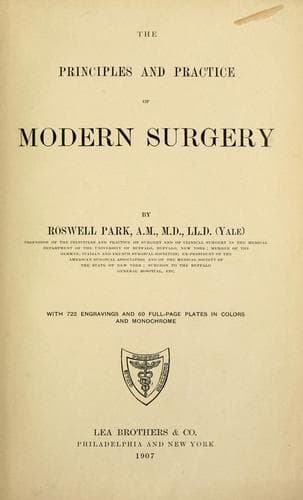
The principles and practice of modern surgeryPark, Roswell
Science
The principles and practice of modern surgery
Park, Roswell
Surgery
1. B. The best example of anemia which depends upon diminution of the
hemoglobin content of the red cells is that known as _chlorosis_. In
this there are few recognizable signs of destruction of corpuscles,
even under chemical microscopic examination; consequently the blood
picture is very simple. The color index is very low, yet similar
conditions may also be seen in syphilis, tuberculosis, and cancer. The
underlying feature of all of these cases is malnutrition.
Within a few years a peculiar form of intense anemia has been described
by Banti and others, and is often spoken of as _splenic anemia_ or
_Banti’s disease_. It is characterized by three stages: first, of
splenic enlargement and anemia; second, a transitional stage; third,
a stage of ascites which increases up to death. It is quite closely
allied to Hanot’s hypertrophic cirrhosis of the liver. It is quite
generally regarded as an example of an infection by some as yet
unknown organism. It is of interest to the surgeon because if the
spleen is removed early there are fair prospects of recovery.
2. A. _Anemias with marked leukocytosis_ include especially those
first spoken of by Virchow as _leukemia_. Originally he applied the
term to a particular alteration of the blood, but it is now made to
cover a group of diseases, all of which are characterized by peculiar
and more or less similar increase of white corpuscles. Sometimes these
are increased to such an extent as to make the blood grossly resemble
a mixture of blood and pus. This resemblance led some of the earlier
observers to speak of the condition as “suppuration of the blood.” The
number of leukocytes is sometimes enormously increased; 1 to 10 of the
red cells is quite common and 1 to 5 not exceedingly rare. Cases have
been known in which the white cells outnumbered the red. In well-marked
cases of leukemia, the red cells will be somewhat diminished, while
the white will number from 100,000 to 500,000 per cubic millimeter.
Accompanying this change in the blood there are alterations in
the spleen, the lymph nodes, and the bone-marrow, sometimes one
predominating, sometimes another. It has been customary in fact to
speak of splenic, lymphatic, and medullary leukemia, but these forms
are not sharply differentiated and a pure type of either form is rare.
In this country we speak mainly of _lymphatic_ and _splenomedullary_
forms, the latter being much more common. The latter is accompanied
by enlargement of the spleen, while in the lymphatic form the lymph
nodes are involved and may become as large as walnuts. In the lymphatic
form over 90 per cent. belong to C and D; in the splenomedullary or
splenomyelogenous form the increase of F and G is most marked, while
A will be reduced to 50 per cent. and D to about 10 per cent. The red
corpuscles are decreased in number, but not necessarily in an inverse
ratio; their number may be reduced even to 2,000,000 in extreme cases.
Public-domain text, read in full here on John Shaqi.
Reviews
Reviews
No reviews yet
Be the first to share your thoughts on this work.
Join the Discussion
Join the discussion
Sign in to leave a comment or review.
Sign InorCreate an account