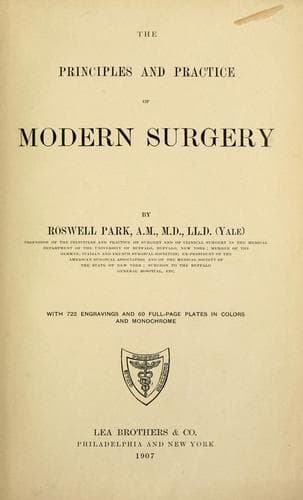
The principles and practice of modern surgeryPark, Roswell
Science
The principles and practice of modern surgery
Park, Roswell
Surgery
=Cupping.=--By the application of “cups,” blood is drawn to the
surface, but ordinarily not abstracted, unless the surfaces have
been previously scarified or incised. _Dry cupping_ has the effect
of attracting blood to one portion of the body, thus drawing it
from another and congested part. It has the temporary effect of a
venesection. Cupping glasses are small tumblers which are rinsed in
alcohol; their edges are wiped and the remaining film within the
glass is ignited from a candle or flame. The glass is then instantly
applied to the affected area. The oxygen within the contained air is
sufficiently consumed to create a slight vacuum and the skin quickly
becomes congested, being sucked upward into the glass. These cups may
be allowed to remain for a few moments, or until they drop off. Care
should be exercised with alcohol and a lighted lamp around a patient
who may be unconscious or excitable, as serious burns have followed
carelessness in this regard. Small vacuum pumps, like the Allen
surgical pump, have been provided for this purpose, and give very
satisfactory results.
There was formerly employed for the purpose of _wet cupping_ a small
spring instrument, containing several sharp knives, by which a series
of incisions were made in order that blood might be drawn. This
instrument cannot be kept clean and is not used at present. When wet
cupping is desired the part should be scarified with a sharp knife and
the cup applied as above.
=Leeching.=--Leeches figure largely in literature of the past, but are
not often used, although they may be made effective, especially when
applied behind the ears in cases of cerebral congestion. The American
leech can be relied on only to abstract about a teaspoonful of blood,
while the Swedish will draw three or four times that amount. The region
to which they are applied must be washed, and, if necessary, shaved.
The part should then be smeared with milk, blood, or sugar-water. The
leeches should be put in a basin of fresh water, after which they are
placed upon a dry towel for two or three minutes. Each one is then
taken up in a small glass or test-tube and inverted over the spot
chosen. As soon as the animal fastens itself upon the skin the glass
may be removed. Leeches are often capricious and will sometimes wait
considerable time before attaching themselves. When full of blood
they usually relax and drop. If it be desired to remove them a little
salt will make them relax. Leeches should never be applied over loose
cellular tissue nor over superficial vessels or nerves. If used in the
interior of a cavity they should be prevented from passing too far.
COUNTERIRRITATION.
Public-domain text, read in full here on John Shaqi.
Reviews
Reviews
No reviews yet
Be the first to share your thoughts on this work.
Elsewhere in the archive
Join the Discussion
Join the discussion
Sign in to leave a comment or review.
Sign InorCreate an account