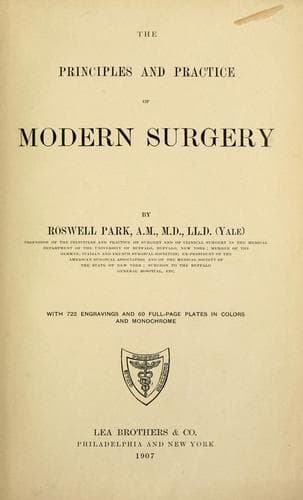
The principles and practice of modern surgeryPark, Roswell
Science
The principles and practice of modern surgery
Park, Roswell
Surgery
Counterirritation is a valuable means of accomplishing that which
is sometimes induced by leeches--namely, attracting blood to the
surface for the relief of deep congestion. In fact it comprises more
than this, since there is some deep influence exerted through the
medium of the nervous system; it not only equalizes the circulation,
but tranquillizes a disturbed innervation. The milder and more
domestic means include the use of the so-called rubefacients--hot
water, mustard, and turpentine. These are of little use in surgical
conditions which call for counterirritation; their use should be
controlled with caution lest mere counterirritation be converted into
actual burning.
By the use of _vesicants_ a blister is produced, _i. e._, an effusion
of serum and lymph beneath the superficial and outside of the deeper
layer of the skin. Mustard and cantharis are the principal vesicants in
common use. The former may be used in full strength, in which case it
is active, or it may be reduced with wheat flour or linseed meal. To
bring out the full strength of mustard, hot water should not be used in
its preparation, as it renders it almost valueless. A mustard paste or
plaster should be watched at intervals, and it should be removed when
the desired effect has been obtained--at all events, when the surface
to which it has been applied is covered with vesicles.
Cantharis, or Spanish fly, is used either in the form of the
cantharidal cerate or mixed with collodion, the latter being the
neatest and most pleasant preparation. Several layers are painted on
the surface where its effect is desired. This is then protected, and
vesication will be found to have been produced within an hour or two,
except where the skin is most resistant. The stronger chemicals, like
ammonia, chloroform, strong iodine, and nitrate of silver solutions,
will be found to be active blistering agents, but should be used with
caution.
Two other methods of irritation were at one time in favor--namely, the
_seton_ and the _issue_. The former consisted of a bundle of threads
or a wick, drawn into a large needle with a lancet-shaped point; the
skin was picked up into a fold, the needle made to traverse it, and the
wick was thus drawn through and cut off, so as to be left in place. The
issue was made by drawing a blister with a powerful agent, and then
preventing it from healing by the use of an irritating foreign body.
These procedures have been abandoned by the medical profession, but are
still in vogue among veterinary surgeons.
Public-domain text, read in full here on John Shaqi.
Reviews
Reviews
No reviews yet
Be the first to share your thoughts on this work.
Elsewhere in the archive
Join the Discussion
Join the discussion
Sign in to leave a comment or review.
Sign InorCreate an account