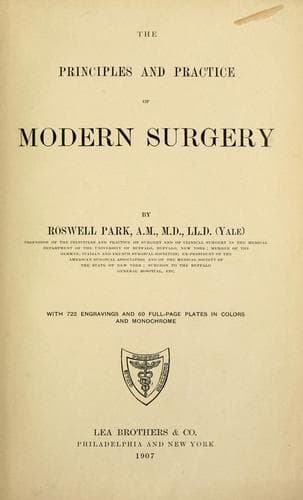
The principles and practice of modern surgeryPark, Roswell
Science
The principles and practice of modern surgery
Park, Roswell
Surgery
The trocar, inserted in the cannula, should be plunged quickly into the
cavity at the site selected. Considerable resistance will be offered
by the skin. If the trocar be small it is enough to anesthetize the
skin; if large, a small incision will permit of its better use. The
instrument makers have provided cannulas of various descriptions, to
which tubing may be attached, so that the fluid may be conducted into
a suitable receptacle, and wetting the patient avoided. It is well to
draw the skin aside and not to make the instrument pass directly into
the cavity to be tapped unless it contain pus and it be desired to
keep it open. If this precaution is taken the skin will cover the deep
opening after it slips back into its position, and will act as a valve
to prevent leakage. In this way infection may be avoided.
When fluid has ceased to be serous and has become purulent, as in
empyema, it is often so thick that it will not flow through any hollow
instrument. In such an event free incision should be made. When the
thorax is involved incision is made between the ribs, and in order to
maintain drainage a good-sized drainage tube should be inserted. This
at times may be so compressed between the ribs that an inch or more of
one rib should be exsected to provide against this possibility.
TRANSFUSION AND INFUSION.
Though much has been said concerning the indications for these
procedures no explicit directions have been given. While they are often
emergency measures they are, nevertheless, frequently practised. In
well-regulated institutions the conveniences are always at hand for
instant resort when needed; but it would be well for every general
practitioner to have ready at all times the few things that are
required, for at least hypodermoclysis. In country practice, however,
a clean fountain syringe, a suitable aspirator needle (both carefully
sterilized), some boiled water, table salt (when nothing else is at
hand), and soap and water for sterilization of the operator’s hands
and the patient’s skin are all that are necessary. In every outfit
there should be a needle which may be used for this purpose. It may
be carried in a glass tube, always sterilized, and ready for use. No
fountain syringe should be used which has not been freshly boiled,
except in an emergency. Tablets containing common salt in definite
amount, so that a solution of given strength can be made by adding them
to a definite amount of water, can be procured. With such a needle, a
few tablets, and a fountain syringe the surgeon is prepared for any
emergency.
For intravenous infusion for which no pressure is required, an ordinary
funnel, with rubber tubing attached, will be sufficient without the use
of a rubber bag.
Public-domain text, read in full here on John Shaqi.
Reviews
Reviews
No reviews yet
Be the first to share your thoughts on this work.
Elsewhere in the archive
Join the Discussion
Join the discussion
Sign in to leave a comment or review.
Sign InorCreate an account