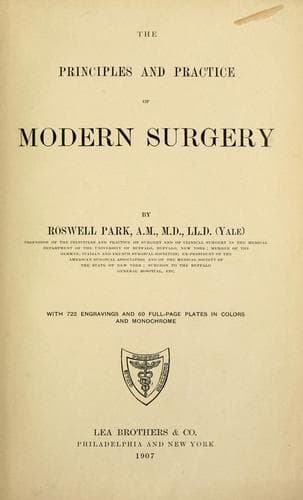
The principles and practice of modern surgeryPark, Roswell
Science
The principles and practice of modern surgery
Park, Roswell
Surgery
The use of salt solution has supplanted the _transfusion of blood_.
This requires a source of blood which is not always at hand and an
amount of attention which can rarely be given in emergencies; moreover,
it has been shown that the injection even of defibrinated blood
is a dangerous procedure, because of liberation of hemoglobin and
destruction of white corpuscles, with the liability to coagulation of
the blood from increase of fibrin ferment, and the possible death of
the patient. Direct transfusion from another person into the veins of
the patient is also difficult, and has rarely been of service.
As already stated in the chapter on Shock, the best solution for
infusion is composed of calcium chloride 2 parts, potassium chloride 3
parts, sodium chloride 9 parts, sterile water, 1000 parts. The addition
of one part of sodium bicarbonate will sometimes prove of advantage,
while in diabetic cases this may be increased to three parts to a
thousand. It has also been suggested to add a small proportion of
sugar, even up to thirty parts, to this solution, in order to increase
osmotic action and better preserve the red corpuscles from injury. It
is supposed also to give a certain nutritive value.
When the fluid is injected into the venous system all that is desired
is that it barely enter; consequently the receptacle containing the
fluid should be held but a few inches above the level of the opening.
When hypodermoclysis is practised more pressure will be needed and a
greater difference of level should be maintained. In the veins the
amount injected should not exceed 100 Cc. each minute. From 500 to 1500
Cc. may be used altogether. There need be no hesitation in introducing
it at a temperature considerably above the body normal, and in cases of
shock it may be introduced even at 115° F. The character of the pulse
will afford the indication as to the amount of fluid to be used as well
as the wisdom of repeating the measure after an interval.
For _intravenous infusion_ a vein in the arm is usually exposed and the
needle point carefully inserted. It is an advantage to have for this
purpose a special needle, made with a blunted extremity, enlarged a
little, so that by the use of a temporary ligature the vein may be held
tightly around the cannula, for such it really is, and the escape of
fluid be prevented. After withdrawal of the needle a double ligature
should be placed for purposes of security. The limb should also be kept
at rest for a few days.
Public-domain text, read in full here on John Shaqi.
Reviews
Reviews
No reviews yet
Be the first to share your thoughts on this work.
Elsewhere in the archive
Join the Discussion
Join the discussion
Sign in to leave a comment or review.
Sign InorCreate an account