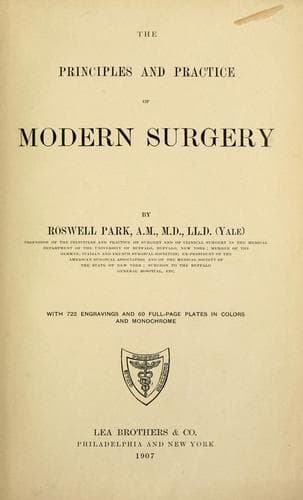
The principles and practice of modern surgeryPark, Roswell
Science
The principles and practice of modern surgery
Park, Roswell
Surgery
Some surgeons leave these dressings for several days. I have found it
an advantage to remove them within thirty-six hours, as sometimes the
grafts appear to be macerated in the fluids and to lose their first
cohesion to the prepared surface. The main thing about the dressing
is that it should be non-adhesive and restful. After three or four
days, when the grafts have completely adhered, any ointment dressing
may be used. It may happen that only a portion of the entire number
of grafts serve their purpose, and that others fail to do their work.
Even when the failure has been apparently considerable it will often
be seen that individual epithelial cells have adhered and later will
grow. The unhealed portions of such a surface now fall within the
definition given earlier of an ulcer, and should be subjected to the
same treatment.
Grafting may be repeated as often as seems to be necessary. The best
surfaces from which to take the grafts are usually the outer aspects
of the arms and thighs. The places from which they are removed need
only the simplest antiseptic dressings. If the grafts have been of
sufficient thinness the scars left by their removal are scarcely
permanent and rarely disfiguring.
Wight, of Brooklyn, has suggested that advantage be taken of the
properties of high-frequency discharges from a suitable apparatus to
secure their hemostatic and coagulant effect. He has shown that such
electrical discharge will clot blood and coagulate albumin, this effect
being partly due to the formation of nitric acid from the air. In this
way it is theoretically possible to so seal the surfaces as to fix
grafts firmly in place. The apparatus calls for a pointed electrode,
passed at a distance of about 1 Cm. above the entire surface, until the
clot is firm and reasonably dry, all serum that is expressed in the
process being removed with sponges. Where the apparatus can be employed
this affords an effective way of fixing the grafts and preventing their
displacement.
Surface epithelium from an animal source may be used when necessary--as
from a young pig after it has left the packing-house, a young calf, or
some smaller animal. All that is required is _epithelium_. That from
a negro will reproduce only pigmented cells like the original. At the
time when amputating a limb about which there is still left healthy
unbroken skin, shavings may be removed from it and preserved for a week
or two between dry sterilized towels or in a weak antiseptic solution;
these may then be utilized for skin grafting during the ensuing few
days.
[Illustration: FIG. 30
Figure-of-8 bandage of leg.]
[Illustration: FIG. 31
Velpeau’s bandage.]
[Illustration: FIG. 32
Ascending spica bandage of the groin.]
BANDAGING.
Bandaging is a subject now taught so generally by actual demonstration,
and so simplified, that it scarcely seems necessary to more than
present a few illustrations showing how simple bandages can be applied
in the most effective manner.
Public-domain text, read in full here on John Shaqi.
Reviews
Reviews
No reviews yet
Be the first to share your thoughts on this work.
Elsewhere in the archive
Join the Discussion
Join the discussion
Sign in to leave a comment or review.
Sign InorCreate an account