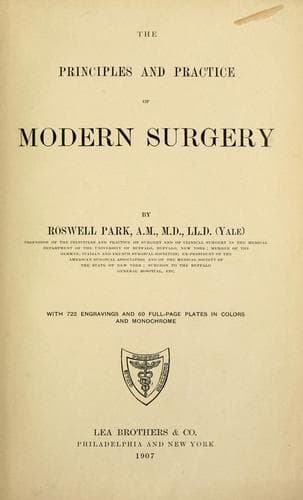
The principles and practice of modern surgeryPark, Roswell
Science
The principles and practice of modern surgery
Park, Roswell
Surgery
The purposes of a bandage are either to afford means of retaining
splints and dressings, to exert pressure, or to afford physiological
rest. After every operation of importance it is necessary to apply and
retain an occlusive and aseptic dressing, under which the wound may
heal or into which wound discharges may be received; but the ideal
dressing affords more than this--it furnishes _support and rest._
[Illustration:
FIG. 33
FIG. 34
Spica bandage of shoulder.]
[Illustration:
FIG. 35
FIG. 36
Third roller of Desault’s bandage.]
There is danger in the injudicious use of any bandage, as by the
exertion of undue pressure it may interfere with wound healing, or may
even lead to gangrene. If applied loosely at the extremity and too
tightly above it will lead to venous obstruction and possibly secondary
hemorrhage. Moreover a bandage which seems properly arranged may become
so tight as to be painful and even unbearable after swelling has
occurred. There is but one safe rule, and that is to take note of the
appearance of the part as well as of the sensations of the patient. An
abdominal bandage may have been placed with a proper degree of snugness
at the conclusion of an operation, and yet be altogether too tight when
the abdomen becomes distended with a little gas. There is then always
room for discretion and good judgment in the matter of bandaging. It
may be necessary to apply a bandage quite firmly at first in order to
repress hemorrhage, with the intention to relax it after a few hours.
A splint may be a necessary feature in a surgical dressing; after
amputating at the lower part of the leg it is advisable to bind the
limb upon a splint in order that the necessary physiological rest
may be thus afforded. The first requisite of a bandage is not its
appearance but its effectiveness; a due regard for the esthetic in
surgery will, however, dictate that it be made as presentable as
possible.
[Illustration: FIG. 37
T-bandage.]
[Illustration: FIG. 38
Kelly’s bandage with perineal straps.]
For the roller bandages of cotton cloth, universally in use twenty-five
years ago, there have been substituted bandages of thin gauze or
crinoline, which have scarcely body enough to be applied, as was the
roller, or else of flannel, made wider and necessarily thicker, which
are more flexible, comfortable, and applicable.
[Illustration: FIG. 39
Barton’s head bandage as employed for suspension in applying
plaster-of-Paris bandage.]
Crinoline impregnated with starch is also in general use and makes a
serviceable bandage for head injuries. When prepared with plaster of
Paris it is capable of affording absolute support and even rigidity.
CHAPTER XX.
ANESTHESIA AND ANESTHETICS, GENERAL AND LOCAL.
Public-domain text, read in full here on John Shaqi.
Reviews
Reviews
No reviews yet
Be the first to share your thoughts on this work.
Elsewhere in the archive
Join the Discussion
Join the discussion
Sign in to leave a comment or review.
Sign InorCreate an account