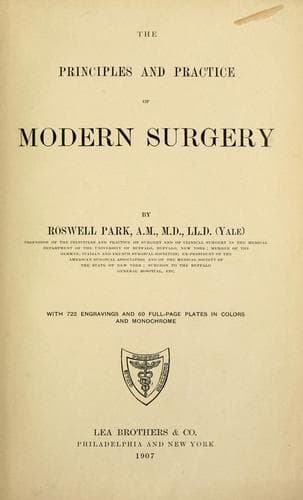
The principles and practice of modern surgeryPark, Roswell
Science
The principles and practice of modern surgery
Park, Roswell
Surgery
Anesthetics are sources of danger, not only for the moment while
they are in use, but because of the disturbances which may follow in
their train. These drugs should never be administered carelessly nor
thoughtlessly, nor by inexperienced individuals, but entrusted to the
wisest and the most discreet. More is expected of the anesthetizer
than that he shall barely keep the patient alive; he should be so
expert as to keep the patient safely on the side of complete anesthesia
and muscle relaxation. Nor should he be willing to yield to the
importunities of an impatient operator who may be continually appealing
to him to crowd the anesthetic. When thus given, and by an expert,
such postanesthetic distress as nausea, vomiting, coughing, etc., may
be avoided. So generally are these facts now realized and appreciated,
that in many of the large hospitals a regular anesthetizer is employed,
whose sole duty it is to administer the anesthetic for the attending
surgeons. The management of an anesthetic has much to do with the
allied subjects of the _preparation of the patient_, the _management of
shock or reduced blood pressure_, and the _status lymphaticus_, which
have already been considered.
Fatal accidents from anesthetics are the appalling ones which have
generally occurred in cases where it has been assumed that the patient
is in good condition, and where neither preliminary examination nor
preparation has been made. In the presence of unmistakable cardiac
disease, or of great arterial tension, the surgeon may, by foreseeing
the possibility of trouble, do much to prevent it; but when an
apparently healthy individual is placed upon the operating table
without attention to these matters it may happen that his heart will
stop as suddenly and unexpectedly as though it had been transfixed.
In other words, the accidents of anesthesia usually occur when least
expected; on the other hand, accidents will be few and far between when
all cases are handled as though promising to be severe ones.
The odor of most anesthetics is so distasteful to patients that they
inhale at first with difficulty and with signs of irritation. Much of
this can be guarded against by spraying the nasopharynx with a 1 or
2 per cent. solution of cocaine. This expedient will make anesthesia
much easier for them. The mouth should be examined; all false teeth or
foreign bodies, such as pins, chewing-gum, etc., should be removed.
Unpleasant burning of the sensitive mucosa of the nose and lips may be
avoided by anointing these parts with cold cream. Attention should be
given to the avoidance of irritation of the eyes or the careless escape
of an anesthetic into the conjunctival sac; with a struggling patient,
or a careless administrator, this may easily happen.
Public-domain text, read in full here on John Shaqi.
Reviews
Reviews
No reviews yet
Be the first to share your thoughts on this work.
Elsewhere in the archive
Join the Discussion
Join the discussion
Sign in to leave a comment or review.
Sign InorCreate an account