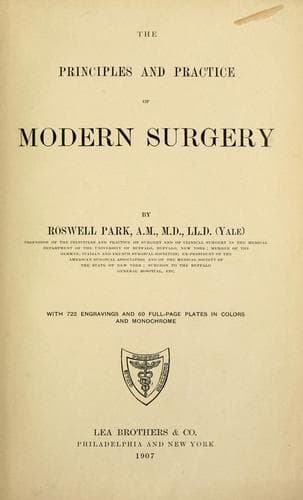
The principles and practice of modern surgeryPark, Roswell
Science
The principles and practice of modern surgery
Park, Roswell
Surgery
To Oliver Wendell Holmes we owe the term _anesthesia_, as generally
employed and made to mean insensibility to pain, no matter how
produced. A more strict definition would limit the term to conditions
comprising not only insensibility to pain but loss of consciousness.
For mere loss of sensation we should, strictly speaking, use the word
_analgesia_. This is a distinction with a difference. Thus I have on
rare occasions seen a patient under chloroform absolutely oblivious to
pain but perfectly conscious, and chatting intelligently throughout
the operation. This is a rare phenomenon, but has been noted by
various observers. So after intraspinal cocaine injections we secure
complete analgesia of the lower portion of the body, but not complete
anesthesia, the former being what we are most anxious to produce.
The discovery of anesthesia is essentially to America’s credit. Long,
of Georgia, had produced anesthesia by ether as early as 1842; Jackson,
of Boston, also claims credit for the discovery; but to Morton, a
dentist of Boston, is undoubtedly due the honor of having introduced it
for surgical purposes. The first public demonstration of its properties
was made by Morton and Warren, October 16, 1846, in the Massachusetts
General Hospital. Chloroform seems to have been exploited independently
by Guthrie, of Sackett’s Harbor, N. Y., and Simpson, of Edinburgh, in
1847. It is a curious historical fact that the patient to whom Simpson
meant first to administer chloroform in his clinic did not receive it
because of some failure to have it on hand; she took ether instead and
died, presumably of the anesthetic. Had she died under the influence
of chloroform it would have been a serious setback to any general
appreciation of its merits. Nitrous oxide is also an anesthetic for
which America may take the credit. These are the three drugs in common
use today, although there are others which are coming into general
favor.
It can be stated as an axiom that when a surgeon tries to abolish
human sensibility, or pass an instrument through the human skin,
he introduces elements of danger which can never be certainly and
completely controlled--that is to say, the administration of an
anesthetic is never to be undertaken as a trifling matter, but should
be entered upon as carefully for a minor procedure as for a dangerous
and prolonged operation.
Public-domain text, read in full here on John Shaqi.
Reviews
Reviews
No reviews yet
Be the first to share your thoughts on this work.
Elsewhere in the archive
Join the Discussion
Join the discussion
Sign in to leave a comment or review.
Sign InorCreate an account