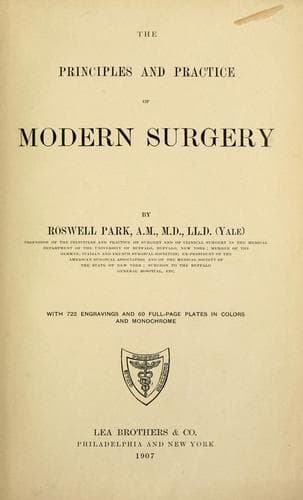
The principles and practice of modern surgeryPark, Roswell
Science
The principles and practice of modern surgery
Park, Roswell
Surgery
hooklets of echinococcus cysts; and, perhaps most often of all, the
_microorganisms_ clinging to some minute fragment of thrombus which
has been dislodged. Embolism is also produced experimentally by the
artificial introduction into the circulating blood of cinnabar or
small particles of pith or other material. Emboli differ in number and
size from the smallest appreciable up to the largest, which may be
met with in the larger venous trunks. They are _dislodged_ from their
primary site sometimes by _accident_, as by rude manipulation, injury,
etc.; sometimes by _undue cardiac activity_, as when detached from a
valve wall; sometimes by the _process of softening_ of thrombus and
a subsequent introduction into the blood stream as a result of some
trifling motion; or even by _spontaneous processes_. Emboli also differ
in numbers according to the nature of the primary lesion. In cases of
so-called fat embolism fluidified fat is taken into the returning blood
stream, carried to the heart, churned up with the contained blood,
and distributed to the lungs in such a way that myriads of minute fat
masses are distributed throughout the capillaries of the lungs, and
free circulation of blood through them is thereby impeded.
It will thus be seen that the relations between thrombosis and embolism
are most intimate, but that either one may occur without the occurrence
of the other.
Among the viscera, with the exception possibly of the brain, the
disastrous consequences of such processes as those just described
are more apparent and indicative than in _thrombosis and embolism
of the mesenteric bloodvessels_--a condition not so rare as journal
articles would imply, yet, nevertheless, one seldom recognized either
during life or after death. Its principal symptoms consist of intense
abdominal pain, bloody diarrhea, subnormal temperature, sometimes with
vomiting, perhaps in the latter stages vomiting of blood. Shock is
usually also extremely marked. The consequence of this condition is
almost inevitably gangrene of the intestine supplied by that particular
portion of the mesenteric vessels. The pain comes on within a short
time after the occurrence, and under the peculiar circumstances
gangrene may be practically determined within a few hours. Some two
hundred and fifty cases of this kind are now on record, and the
condition is one well worth the prompt attention of the surgeon,
because only by surgical intervention--_i. e._, by resection of the
necrotic mass of intestine--can life possibly be saved. That when a
limited portion of the intestine is involved the gangrenous part may be
successfully removed has been proved by several operators. (See Chapter
LII.)
Public-domain text, read in full here on John Shaqi.
Reviews
Reviews
No reviews yet
Be the first to share your thoughts on this work.
Join the Discussion
Join the discussion
Sign in to leave a comment or review.
Sign InorCreate an account