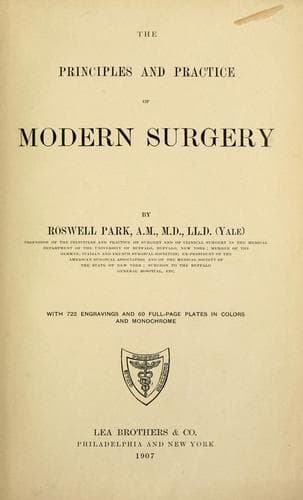
The principles and practice of modern surgeryPark, Roswell
Science
The principles and practice of modern surgery
Park, Roswell
Surgery
=Abscess.=--An abscess is a _circumscribed collection of pus_. The term
is used in contradistinction to _purulent infiltration_, in which the
collection is not circumscribed, but is exceedingly diffuse and extends
itself in various directions, the amount at any spot being almost
inappreciable. Purulent infiltration is regarded as the more serious
of the two conditions, as it is more difficult for pus to escape under
these circumstances than when it can be evacuated through a single
opening. The term _phlegmon_ is one now generally used to indicate
a suppurative process, usually of the general character of purulent
infiltration rather than of abrupt abscess, but generally employed to
include both conditions. The adjective _phlegmonous_ is coupled with
the names of other surgical infectious diseases to indicate that it
is complicated by suppuration, _e. g._, phlegmonous erysipelas. _Pus_
is a product of bacterial activity usually formed rapidly rather than
otherwise, and abscess formation or phlegmonous activity of any kind is
a question of but a few days. _Empyema_ means a collection of pus in a
preëxisting cavity.
The significance of this condition is well described in the story of
inflammation and suppuration, to paraphrase Sutton, read zoölogically,
as though it were the story of a battle: The leukocytes (phagocytes)
are the defending army, the vessels its lines of communication, the
leukocytes being, in effect, the standing army maintained by every
composite organism. When this body is invaded by bacteria or other
irritants, information of the invasion is telegraphed by means
of the vasomotor nerves, and leukocytes are pushed to the front,
reinforcements being rapidly furnished, so that the standing army of
white corpuscles may be increased to thirty or forty times the normal
standard. In this conflict cells die, and often are eaten by their
companions. Frequently the slaughter is so great that the tissues
become burdened by the dead bodies of the soldiers in the form of
pus, the activity of the cells being proved by the fact that their
protoplasm often contains bacilli in various stages of destruction.
These dead cells, like the corpses of soldiers who fall in battle,
later become hurtful to the organism which, during their lives, it was
their duty to protect, for they are fertile sources of septicemia and
pyemia. This illustration may seem romantic, but is warranted by the
facts.
Public-domain text, read in full here on John Shaqi.
Reviews
Reviews
No reviews yet
Be the first to share your thoughts on this work.
Elsewhere in the archive
Join the Discussion
Join the discussion
Sign in to leave a comment or review.
Sign InorCreate an account