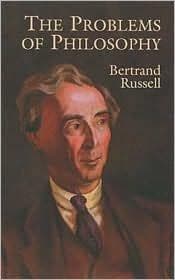
Knowledge, Theory of; Metaphysics; Philosophy -- Introductions
This function, at least, philosophy can perform. Most philosophers,
rightly or wrongly, believe that philosophy can do much more than
this--that it can give us knowledge, not otherwise attainable,
concerning the universe as a whole, and concerning the nature of
ultimate reality. Whether this be the case or not, the more modest
function we have spoken of can certainly be performed by philosophy, and
certainly suffices, for those who have once begun to doubt the adequacy
of common sense, to justify the arduous and difficult labours that
philosophical problems involve.
CHAPTER III. THE NATURE OF MATTER
In the preceding chapter we agreed, though without being able to
find demonstrative reasons, that it is rational to believe that our
sense-data--for example, those which we regard as associated with my
table--are really signs of the existence of something independent of us
and our perceptions. That is to say, over and above the sensations of
colour, hardness, noise, and so on, which make up the appearance of
the table to me, I assume that there is something else, of which these
things are appearances. The colour ceases to exist if I shut my eyes,
the sensation of hardness ceases to exist if I remove my arm from
contact with the table, the sound ceases to exist if I cease to rap the
table with my knuckles. But I do not believe that when all these things
cease the table ceases. On the contrary, I believe that it is because
the table exists continuously that all these sense-data will reappear
when I open my eyes, replace my arm, and begin again to rap with my
knuckles. The question we have to consider in this chapter is: What
is the nature of this real table, which persists independently of my
perception of it?
To this question physical science gives an answer, somewhat incomplete
it is true, and in part still very hypothetical, but yet deserving of
respect so far as it goes. Physical science, more or less unconsciously,
has drifted into the view that all natural phenomena ought to be reduced
to motions. Light and heat and sound are all due to wave-motions, which
travel from the body emitting them to the person who sees light or feels
heat or hears sound. That which has the wave-motion is either aether or
'gross matter', but in either case is what the philosopher would call
matter. The only properties which science assigns to it are position in
space, and the power of motion according to the laws of motion. Science
does not deny that it _may_ have other properties; but if so, such other
properties are not useful to the man of science, and in no way assist
him in explaining the phenomena.
Public-domain text, read in full here on John Shaqi.
Reviews
Reviews
No reviews yet
Be the first to share your thoughts on this work.
Join the Discussion
Join the discussion
Sign in to leave a comment or review.
Sign InorCreate an account