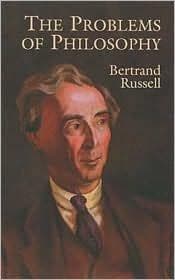
Knowledge, Theory of; Metaphysics; Philosophy -- Introductions
This question of the distinction between act and object in our
apprehending of things is vitally important, since our whole power of
acquiring knowledge is bound up with it. The faculty of being acquainted
with things other than itself is the main characteristic of a mind.
Acquaintance with objects essentially consists in a relation between the
mind and something other than the mind; it is this that constitutes the
mind's power of knowing things. If we say that the things known must be
in the mind, we are either unduly limiting the mind's power of knowing,
or we are uttering a mere tautology. We are uttering a mere tautology if
we mean by '_in_ the mind' the same as by '_before_ the mind', i.e. if
we mean merely being apprehended by the mind. But if we mean this, we
shall have to admit that what, _in this sense_, is in the mind,
may nevertheless be not mental. Thus when we realize the nature of
knowledge, Berkeley's argument is seen to be wrong in substance as well
as in form, and his grounds for supposing that 'ideas'--i.e. the objects
apprehended--must be mental, are found to have no validity whatever.
Hence his grounds in favour of idealism may be dismissed. It remains to
see whether there are any other grounds.
It is often said, as though it were a self-evident truism, that we
cannot know that anything exists which we do not know. It is inferred
that whatever can in any way be relevant to our experience must be at
least capable of being known by us; whence it follows that if matter
were essentially something with which we could not become acquainted,
matter would be something which we could not know to exist, and which
could have for us no importance whatever. It is generally also implied,
for reasons which remain obscure, that what can have no importance for
us cannot be real, and that therefore matter, if it is not composed of
minds or of mental ideas, is impossible and a mere chimaera.
To go into this argument fully at our present stage would be impossible,
since it raises points requiring a considerable preliminary discussion;
but certain reasons for rejecting the argument may be noticed at
once. To begin at the end: there is no reason why what cannot have any
_practical_ importance for us should not be real. It is true that,
if _theoretical_ importance is included, everything real is of _some_
importance to us, since, as persons desirous of knowing the truth about
the universe, we have some interest in everything that the universe
contains. But if this sort of interest is included, it is not the case
that matter has no importance for us, provided it exists even if we
cannot know that it exists. We can, obviously, suspect that it may
exist, and wonder whether it does; hence it is connected with our desire
for knowledge, and has the importance of either satisfying or thwarting
this desire.
Public-domain text, read in full here on John Shaqi.
Reviews
Reviews
No reviews yet
Be the first to share your thoughts on this work.
Join the Discussion
Join the discussion
Sign in to leave a comment or review.
Sign InorCreate an account