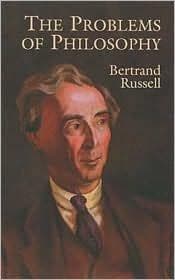
Knowledge, Theory of; Metaphysics; Philosophy -- Introductions
When we say 'the so-and-so exists', we mean that there is just one
object which is the so-and-so. The proposition '_a_ is the so-and-so'
means that _a_ has the property so-and-so, and nothing else has. 'Mr.
A. is the Unionist candidate for this constituency' means 'Mr. A. is
a Unionist candidate for this constituency, and no one else is'. 'The
Unionist candidate for this constituency exists' means 'some one is a
Unionist candidate for this constituency, and no one else is'. Thus,
when we are acquainted with an object which is the so-and-so, we know
that the so-and-so exists; but we may know that the so-and-so exists
when we are not acquainted with any object which we know to be the
so-and-so, and even when we are not acquainted with any object which, in
fact, is the so-and-so.
Common words, even proper names, are usually really descriptions. That
is to say, the thought in the mind of a person using a proper name
correctly can generally only be expressed explicitly if we replace the
proper name by a description. Moreover, the description required to
express the thought will vary for different people, or for the same
person at different times. The only thing constant (so long as the name
is rightly used) is the object to which the name applies. But so long as
this remains constant, the particular description involved usually makes
no difference to the truth or falsehood of the proposition in which the
name appears.
Let us take some illustrations. Suppose some statement made about
Bismarck. Assuming that there is such a thing as direct acquaintance
with oneself, Bismarck himself might have used his name directly to
designate the particular person with whom he was acquainted. In this
case, if he made a judgement about himself, he himself might be a
constituent of the judgement. Here the proper name has the direct use
which it always wishes to have, as simply standing for a certain object,
and not for a description of the object. But if a person who knew
Bismarck made a judgement about him, the case is different. What this
person was acquainted with were certain sense-data which he connected
(rightly, we will suppose) with Bismarck's body. His body, as a physical
object, and still more his mind, were only known as the body and the
mind connected with these sense-data. That is, they were known by
description. It is, of course, very much a matter of chance which
characteristics of a man's appearance will come into a friend's mind
when he thinks of him; thus the description actually in the friend's
mind is accidental. The essential point is that he knows that the
various descriptions all apply to the same entity, in spite of not being
acquainted with the entity in question.
Public-domain text, read in full here on John Shaqi.
Reviews
Reviews
No reviews yet
Be the first to share your thoughts on this work.
Join the Discussion
Join the discussion
Sign in to leave a comment or review.
Sign InorCreate an account