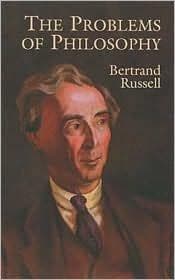
Knowledge, Theory of; Metaphysics; Philosophy -- Introductions
(2) _The law of contradiction_: 'Nothing can both be and not be.'
(3) _The law of excluded middle_: 'Everything must either be or not be.'
These three laws are samples of self-evident logical principles, but
are not really more fundamental or more self-evident than various other
similar principles: for instance, the one we considered just now, which
states that what follows from a true premiss is true. The name 'laws of
thought' is also misleading, for what is important is not the fact that
we think in accordance with these laws, but the fact that things behave
in accordance with them; in other words, the fact that when we think in
accordance with them we think _truly_. But this is a large question, to
which we must return at a later stage.
In addition to the logical principles which enable us to prove from
a given premiss that something is _certainly_ true, there are other
logical principles which enable us to prove, from a given premiss,
that there is a greater or less probability that something is true. An
example of such principles--perhaps the most important example is the
inductive principle, which we considered in the preceding chapter.
One of the great historic controversies in philosophy is the controversy
between the two schools called respectively 'empiricists' and
'rationalists'. The empiricists--who are best represented by the
British philosophers, Locke, Berkeley, and Hume--maintained that all
our knowledge is derived from experience; the rationalists--who are
represented by the Continental philosophers of the seventeenth century,
especially Descartes and Leibniz--maintained that, in addition to what
we know by experience, there are certain 'innate ideas' and 'innate
principles', which we know independently of experience. It has now
become possible to decide with some confidence as to the truth or
falsehood of these opposing schools. It must be admitted, for the
reasons already stated, that logical principles are known to us, and
cannot be themselves proved by experience, since all proof presupposes
them. In this, therefore, which was the most important point of the
controversy, the rationalists were in the right.
Public-domain text, read in full here on John Shaqi.
Reviews
Reviews
No reviews yet
Be the first to share your thoughts on this work.
Join the Discussion
Join the discussion
Sign in to leave a comment or review.
Sign InorCreate an account