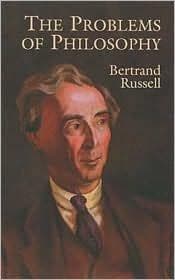
Knowledge, Theory of; Metaphysics; Philosophy -- Introductions
It will help us in considering these questions to have a few simple
terms of which the meaning is definite and clear. Let us give the name
of 'sense-data' to the things that are immediately known in sensation:
such things as colours, sounds, smells, hardnesses, roughnesses, and
so on. We shall give the name 'sensation' to the experience of being
immediately aware of these things. Thus, whenever we see a colour,
we have a sensation _of_ the colour, but the colour itself is a
sense-datum, not a sensation. The colour is that _of_ which we are
immediately aware, and the awareness itself is the sensation. It is
plain that if we are to know anything about the table, it must be
by means of the sense-data--brown colour, oblong shape, smoothness,
etc.--which we associate with the table; but, for the reasons which have
been given, we cannot say that the table is the sense-data, or even
that the sense-data are directly properties of the table. Thus a problem
arises as to the relation of the sense-data to the real table, supposing
there is such a thing.
The real table, if it exists, we will call a 'physical object'. Thus
we have to consider the relation of sense-data to physical objects.
The collection of all physical objects is called 'matter'. Thus our two
questions may be re-stated as follows: (1) Is there any such thing as
matter? (2) If so, what is its nature?
The philosopher who first brought prominently forward the reasons
for regarding the immediate objects of our senses as not existing
independently of us was Bishop Berkeley (1685-1753). His _Three
Dialogues between Hylas and Philonous, in Opposition to Sceptics and
Atheists_, undertake to prove that there is no such thing as matter at
all, and that the world consists of nothing but minds and their ideas.
Hylas has hitherto believed in matter, but he is no match for Philonous,
who mercilessly drives him into contradictions and paradoxes, and makes
his own denial of matter seem, in the end, as if it were almost common
sense. The arguments employed are of very different value: some are
important and sound, others are confused or quibbling. But Berkeley
retains the merit of having shown that the existence of matter is
capable of being denied without absurdity, and that if there are any
things that exist independently of us they cannot be the immediate
objects of our sensations.
Public-domain text, read in full here on John Shaqi.
Reviews
Reviews
No reviews yet
Be the first to share your thoughts on this work.
Join the Discussion
Join the discussion
Sign in to leave a comment or review.
Sign InorCreate an account