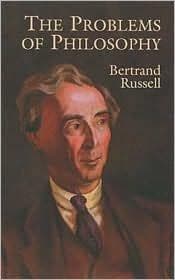
Knowledge, Theory of; Metaphysics; Philosophy -- Introductions
The mathematicians, however, have not been content with showing that
space as it is commonly supposed to be is possible; they have shown also
that many other forms of space are equally possible, so far as logic
can show. Some of Euclid's axioms, which appear to common sense to be
necessary, and were formerly supposed to be necessary by philosophers,
are now known to derive their appearance of necessity from our mere
familiarity with actual space, and not from any _a priori_ logical
foundation. By imagining worlds in which these axioms are false, the
mathematicians have used logic to loosen the prejudices of common
sense, and to show the possibility of spaces differing--some more, some
less--from that in which we live. And some of these spaces differ so
little from Euclidean space, where distances such as we can measure are
concerned, that it is impossible to discover by observation whether our
actual space is strictly Euclidean or of one of these other kinds.
Thus the position is completely reversed. Formerly it appeared that
experience left only one kind of space to logic, and logic showed this
one kind to be impossible. Now, logic presents many kinds of space as
possible apart from experience, and experience only partially decides
between them. Thus, while our knowledge of what is has become less
than it was formerly supposed to be, our knowledge of what may be is
enormously increased. Instead of being shut in within narrow walls, of
which every nook and cranny could be explored, we find ourselves in an
open world of free possibilities, where much remains unknown because
there is so much to know.
What has happened in the case of space and time has happened, to some
extent, in other directions as well. The attempt to prescribe to the
universe by means of _a priori_ principles has broken down; logic,
instead of being, as formerly, the bar to possibilities, has become the
great liberator of the imagination, presenting innumerable alternatives
which are closed to unreflective common sense, and leaving to experience
the task of deciding, where decision is possible, between the many
worlds which logic offers for our choice. Thus knowledge as to what
exists becomes limited to what we can learn from experience--not to
what we can actually experience, for, as we have seen, there is much
knowledge by description concerning things of which we have no direct
experience. But in all cases of knowledge by description, we need some
connexion of universals, enabling us, from such and such a datum, to
infer an object of a certain sort as implied by our datum. Thus in
regard to physical objects, for example, the principle that sense-data
are signs of physical objects is itself a connexion of universals; and
it is only in virtue of this principle that experience enables us to
acquire knowledge concerning physical objects. The same applies to
the law of causality, or, to descend to what is less general, to such
principles as the law of gravitation.
Public-domain text, read in full here on John Shaqi.
Reviews
Reviews
No reviews yet
Be the first to share your thoughts on this work.
Elsewhere in the archive
Join the Discussion
Join the discussion
Sign in to leave a comment or review.
Sign InorCreate an account