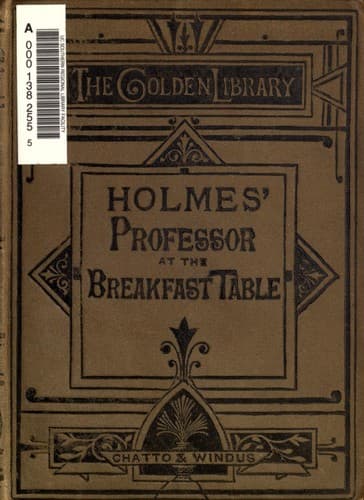
The Professor at the Breakfast-TableHolmes, Oliver Wendell
General
The Professor at the Breakfast-Table
Holmes, Oliver Wendell
American fiction -- 19th century; Conversation -- Fiction; Poetry
Jeremy Bentham's logic, by which he proved that he couldn't possibly see
a ghost is all very well-in the day-time. All the reason in the world
will never get those impressions of childhood, created by just such
circumstances as I have been telling, out of a man's head. That is the
only excuse I have to give for the nervous kind of curiosity with which
I watch my little neighbor, and the obstinacy with which I lie awake
whenever I hear anything going on in his chamber after midnight.
But whatever further observations I may have made must be deferred for
the present. You will see in what way it happened that my thoughts were
turned from spiritual matters to bodily ones, and how I got my fancy
full of material images,--faces, heads, figures, muscles, and so
forth,--in such a way that I should have no chance in this number to
gratify any curiosity you may feel, if I had the means of so doing.
Indeed, I have come pretty near omitting my periodical record this time.
It was all the work of a friend of mine, who would have it that I
should sit to him for my portrait. When a soul draws a body in the great
lottery of life, where every one is sure of a prize, such as it is, the
said soul inspects the said body with the same curious interest with
which one who has ventured into a “gift enterprise” examines the
“massive silver pencil-case” with the coppery smell and impressible
tube, or the “splendid gold ring” with the questionable specific
gravity, which it has been his fortune to obtain in addition to his
purchase.
The soul, having studied the article of which it finds itself
proprietor, thinks, after a time, it knows it pretty well. But there is
this difference between its view and that of a person looking at us:--we
look from within, and see nothing but the mould formed by the elements
in which we are incased; other observers look from without, and see
us as living statues. To be sure, by the aid of mirrors, we get a few
glimpses of our outside aspect; but this occasional impression is always
modified by that look of the soul from within outward which none but
ourselves can take. A portrait is apt, therefore, to be a surprise to
us. The artist looks only from without. He sees us, too, with a hundred
aspects on our faces we are never likely to see. No genuine expression
can be studied by the subject of it in the looking-glass.
Public-domain text, read in full here on John Shaqi.
Reviews
Reviews
No reviews yet
Be the first to share your thoughts on this work.
Elsewhere in the archive
Join the Discussion
Join the discussion
Sign in to leave a comment or review.
Sign InorCreate an account